The fundamental mechanism of digital discovery is undergoing its most radical transformation in twenty-five years. As OpenAI launches SearchGPT and conversational AI assistants absorb hundreds of millions of daily queries, the traditional objective of ranking for “ten blue links” is no longer sufficient. Forward-thinking marketing leaders are now pivoting to Generative Engine Optimization (GEO)—the discipline of engineering web assets so large language models select, synthesize, and cite your brand as their primary source of truth.
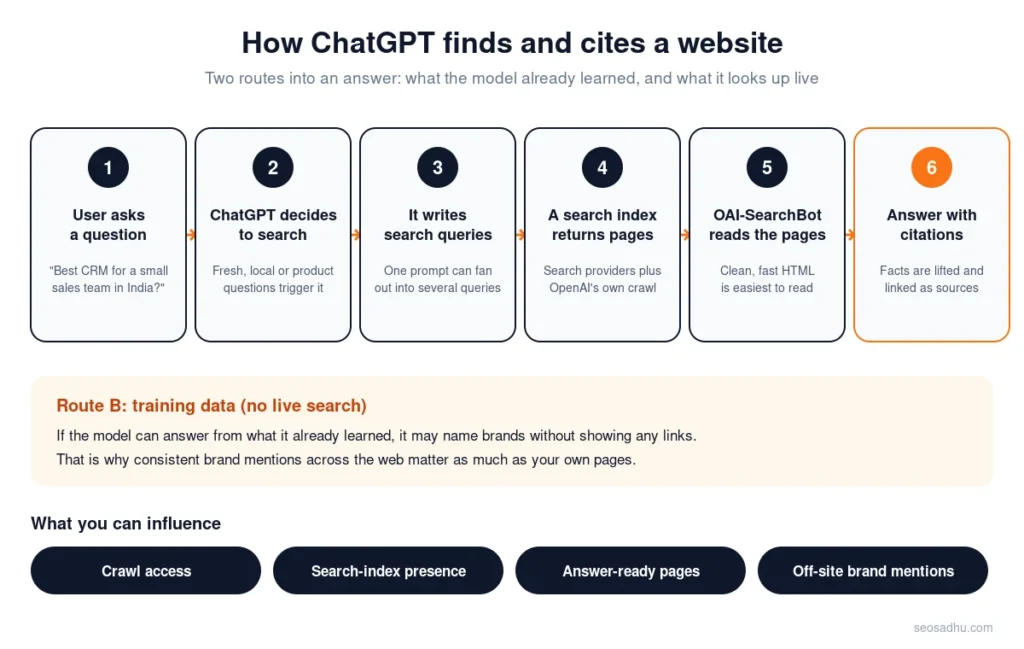
- The Retrieval-Augmented Generation (RAG) Architecture: SearchGPT does not search the web blindly; it pairs real-time search index feeds (primarily Microsoft Bing) with fine-tuned LLM synthesizers. If your site blocks
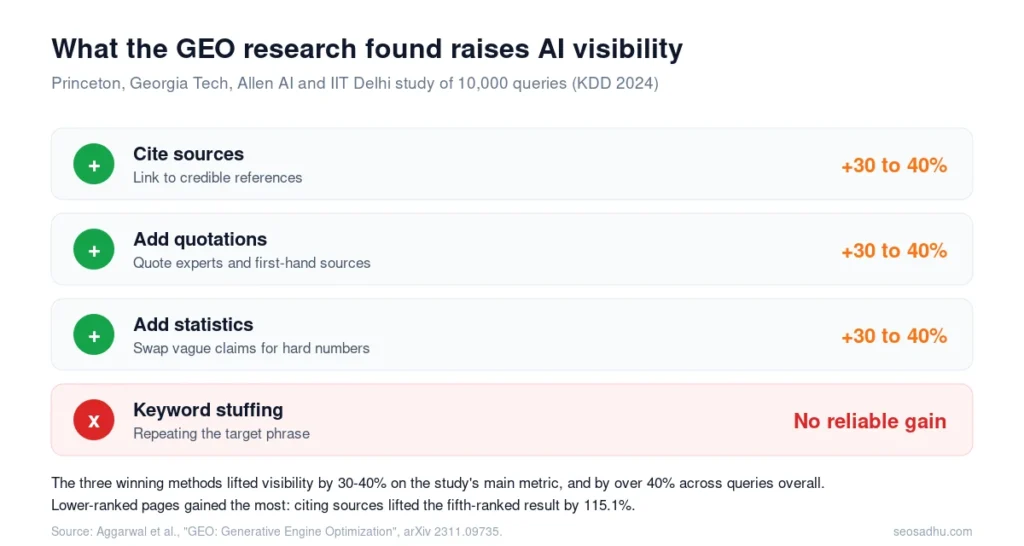
OAI-SearchBotor lacks semantic clarity, you are completely omitted from AI responses. - The 40% Visibility Lift from Statistics & Quotes: Groundbreaking academic research by Princeton and Georgia Tech reveals that adding original statistics, authoritative expert quotes, and explicit technical citations increases an asset’s visibility in generative search by up to 41.5%.
- High-Intent Conversion Psychology: Visitors clicking through from conversational search results exhibit a 3x higher conversion rate than traditional search traffic because the AI model has already pre-qualified your solution during synthesis.
Traditional SEO vs. Generative Engine Optimization (GEO)
Understanding the architectural divergence between legacy ranking algorithms and modern generative engines is essential for allocating marketing capital:
| Vector | Traditional SEO (Google Search) | Generative Engine Optimization (SearchGPT) |
|---|---|---|
| Core Objective | Win positions #1–#3 on keyword SERPs for user clicks. | Become the cited authority inside synthesized conversational answers. |
| Information Structure | Fluffy, long-form articles designed to increase dwell time. | Concise, highly structured semantic data, key takeaways & tables. |
| Primary Search Index | Googlebot proprietary search web index. | OAI-SearchBot, Bing Search API, and direct publisher partner feeds. |
| Authority Metrics | Backlink volume, domain rating (DR), PageRank. | Entity cross-verification, brand co-occurrence & original empirical data. |
How SearchGPT Retrieves and Cites Information
SearchGPT does not read web pages like human visitors. It evaluates text through high-dimensional semantic vector spaces. When a user submits an inquiry, the retrieval process operates through three distinct layers:
1. Semantic Chunking & Passage Retrieval
The engine breaks your content into discrete, context-rich chunks (typically 200–500 tokens). If an answer requires wading through five paragraphs of generic filler, the LLM drops the chunk in favor of a competitor who states the direct answer in the opening two sentences.
2. Factual Density & Empirical Claims
Generative models prioritize high-information gain. Content filled with verifiable numbers, survey data, cost ranges, and specific dates receives significantly higher retrieval weights than subjective commentary.
3. The OAI-SearchBot Crawler Permission Layer
Many webmasters accidentally blocked OpenAI’s original training bot (GPTBot) to protect copyright, inadvertently also blocking OAI-SearchBot. Blocking OAI-SearchBot completely blinds SearchGPT to your real-time content, pricing, and product launches. Ensure your robots.txt permits search crawling:
Allow: /
User-agent: ChatGPT-User
Allow: /
The 5-Step GEO Playbook to Rank in SearchGPT
1. Lead with Direct-Answer Summaries (The BLUF Model)
Adopt the military standard: Bottom Line Up Front (BLUF). Place direct, self-contained 40-to-60-word answers directly beneath every major H2 headline. When SearchGPT extracts context for synthesized answers, these concise definitions become the exact snippet quoted in the conversational card.
2. Embed Original Proprietary Data Studies
Generative engines love citing the primary source of an empirical claim. Publish annual industry benchmarks, pricing surveys, or platform data studies. When competitors quote your numbers, SearchGPT’s entity graph links your domain as the root factual authority.
3. Structure Content with Semantic Comparison Tables
LLMs excel at parsing structured markdown tables and clean HTML tables. When comparing software features, vendor pricing, or technical specifications, format the data in responsive tables. SearchGPT routinely converts tabular data directly into comparative bullet points.
4. Establish Multi-Platform Brand Consensus
SearchGPT evaluates brand credibility across multiple independent digital touchpoints. If your brand is praised on your own website but absent on Reddit, LinkedIn, G2, Crunchbase, and Wikipedia, the LLM flags your brand as an unverified entity. Build consistent entity citations across all authoritative industry hubs.
5. Implement Deep Semantic JSON-LD Schema
Structured schema provides explicit, machine-readable instructions. Utilize Schema.org’s TechArticle, FAQPage, Product, and Organization schemas, specifying the knowsAbout, sameAs, and hasPart properties to anchor your brand firmly in knowledge graphs.
Prepare Your Enterprise Brand for the AI Search Era
At SEO Sadhu, we engineer future-proof search visibility. Our Generative Engine Optimization (GEO) audits ensure your company dominates both traditional Google SERPs and emerging conversational platforms like SearchGPT, Perplexity AI, and Claude.
Frequently Asked Questions (FAQ)
Will SearchGPT completely replace Google search?
SearchGPT is capturing significant market share in exploratory, comparative, and research-heavy commercial queries. Rather than replacing Google entirely, search behavior is fragmenting: users rely on conversational AI for deep answers and vendor vetting, while utilizing Google for navigational and local queries.
Does ranking #1 on Google guarantee inclusion in SearchGPT answers?
No. Independent research shows that only a small percentage of URLs cited inside conversational AI answers hold the #1 ranking on Google. Generative engines prioritize factual density, passage relevance, and semantic authority over raw backlink PageRank.
How do we track referral traffic coming from SearchGPT and ChatGPT?
Monitor referral traffic in Google Analytics 4 under source/medium filters matching chatgpt.com / referral or openai.com / referral. You can also analyze server logs for user-agent traffic matching ChatGPT-User.