More people now ask ChatGPT a question before they type it into Google. When it answers, it names a handful of brands and links to a few sources. If your website is not one of them, you are invisible at the exact moment someone is deciding. This guide explains how to rank your website on ChatGPT in 2026: how the assistant actually picks sources, the 12 steps that make your pages quotable, the tools to track it, and the mistakes that waste time.
Quick answer
To rank your website on ChatGPT, let OpenAI’s search crawler (OAI-SearchBot) reach your pages, make sure they are indexed by the search providers it draws on, write pages that answer questions directly with facts and cited sources, and earn mentions of your brand on the sites it already trusts. Then measure progress with monthly prompt tests and AI referral data in GA4.
Key takeaways
- There is no “position 1” in ChatGPT. Ranking means being cited as a source or named as a recommendation in the answer.
- If you block
OAI-SearchBot, OpenAI says your site will not be shown in ChatGPT search answers. BlockingGPTBotonly opts you out of training. - It runs its own searches. In one Ahrefs study, only 6.82% of the pages it pulled were in Google’s top 10, so a good Google ranking is not enough on its own.
- Research on generative engines found that adding citations, quotations and statistics raised visibility by 30-40%, while keyword stuffing did not help.
- Off-site reputation matters: mentions in reviews, roundups, forums and media shape what the assistant says about you.
- AI referral traffic is still small, but it converts well. Track it, and test the prompts your buyers actually use.
What does “ranking on ChatGPT” actually mean?
On Google, ranking is simple to describe: your page sits at a position on a results page. This assistant has no results page. It writes an answer, and your website can show up in that answer in three ways:
- As a cited source. It links to your page next to the facts it took from it, or lists it under “Sources”. This only happens when it searches the web for the answer.
- As a named recommendation. It mentions your brand (“For small sales teams, consider X or Y”), sometimes with a link and sometimes without.
- As a product result. For shopping questions, it can show products with prices and merchants.
So when people ask how to rank your website on ChatGPT, the honest version of the question is: how do I become one of the few sources the assistant trusts enough to quote, and one of the few brands it trusts enough to recommend? OpenAI is clear that nobody can buy or guarantee this. Its help centre says it “ranks search results using multiple factors intended to help users find relevant, reliable information. Placement is not guaranteed.” (OpenAI Help Center)
That also rules out a shortcut people often ask about. The assistant now carries ads for some users, but OpenAI states that “Ads do not influence ChatGPT’s answers. Ads run on separate systems from our chat model, and advertisers have no ability to shape, rank, or alter ChatGPT’s responses.” (OpenAI, Ads in ChatGPT) Organic visibility has to be earned.
Why ChatGPT visibility matters in 2026
A few numbers show why this is no longer a side project:
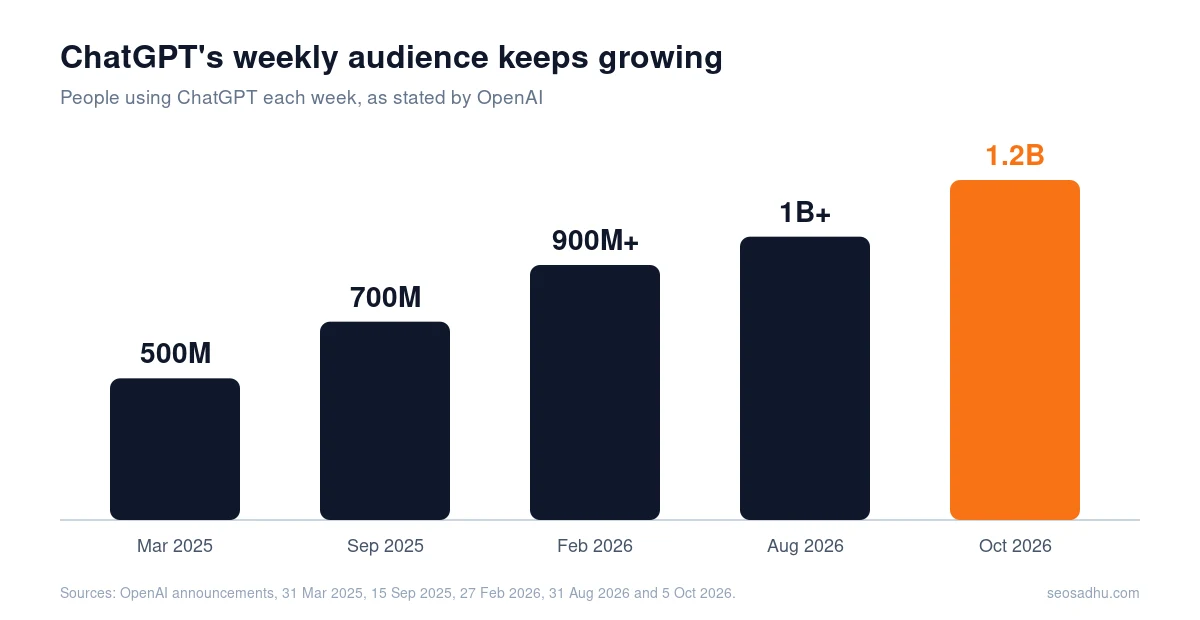
- The audience is huge. OpenAI says ChatGPT “reaches 1.2 billion people each week” (OpenAI, 5 Oct 2026), up from 500 million in March 2025.
- People use it to search. Pew Research Center found that “about four-in-ten U.S. adults say they use chatbots for information searching” (Pew, June 2026).
- AI referrals are growing fast. Similarweb reports that AI platforms drove an average of 770.7 million referral visits a month between June 2025 and May 2026, up 117.4% on the year before (Similarweb).
- Analysts saw this coming. In 2024 Gartner predicted that “by 2026, traditional search engine volume will drop 25%, with search marketing losing market share to AI chatbots and other virtual agents” (Gartner).
Keep the numbers in proportion. For the average website, AI chatbots are still a small slice of traffic: Ahrefs measured 0.17% across 3,000 sites, with ChatGPT the biggest single referrer at 50% of AI traffic (Ahrefs). The reason to act now is the quality of that traffic and the head start it gives you.
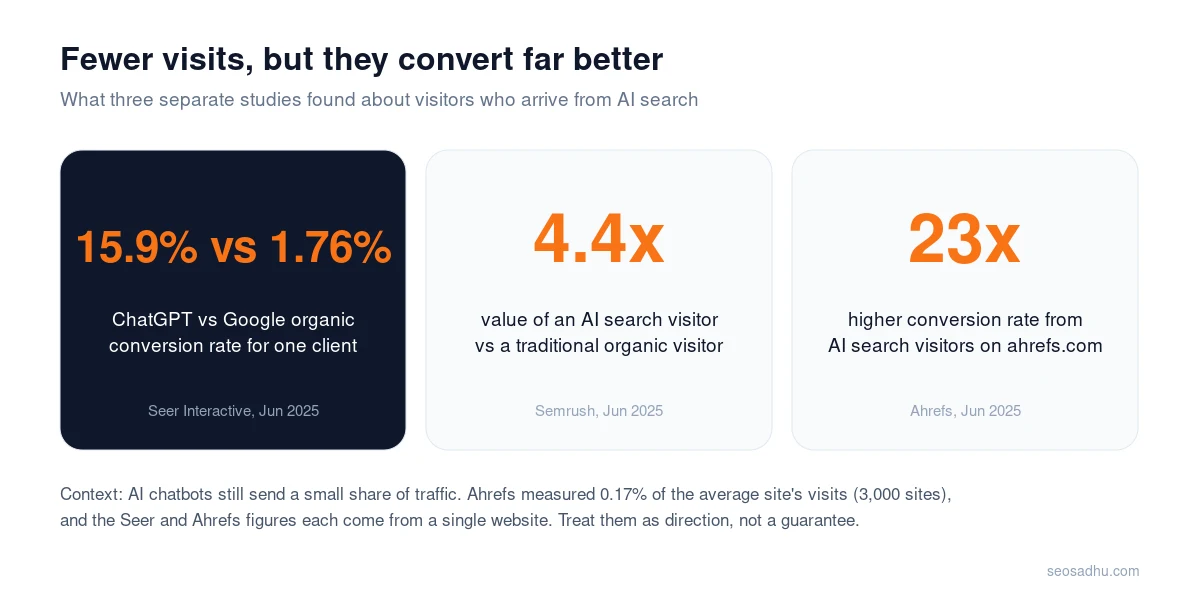
When someone clicks through from an AI answer, they have usually already read a summary and chosen you. In Seer Interactive’s client study, ChatGPT visitors converted at 15.9% against 1.76% for Google organic (Seer Interactive). Semrush estimates the average AI search visitor is worth 4.4 times a traditional organic visitor based on conversion rate (Semrush), and Ahrefs saw AI search visitors convert at 23 times the rate of organic visitors on its own site (Ahrefs).
How ChatGPT finds and chooses its sources
You cannot optimise for a system you do not understand, so here is the short version of how it decides what to say and whom to cite.
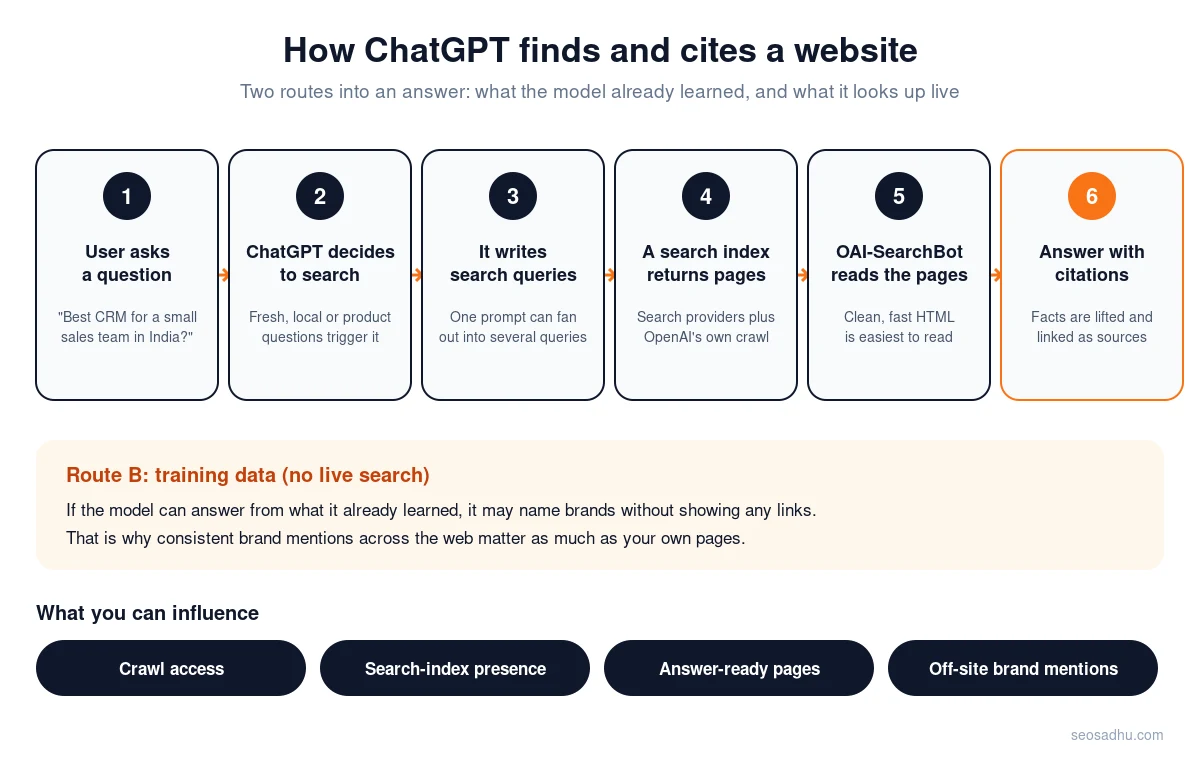
Route 1: live search (where citations come from)
OpenAI’s launch post said ChatGPT “will choose to search the web based on what you ask” (OpenAI). Questions about recent events, prices, local businesses, products and specific facts are the ones most likely to trigger a search. When it searches:
- It rewrites your question into search queries. Ahrefs found that it runs about 1.78 searches per prompt, which the industry calls “fan-out” queries (Ahrefs).
- It uses third-party search providers and partner content. OpenAI says its search “leverages third-party search providers, as well as content provided directly by our partners” (OpenAI). The search help article links to Microsoft’s and Shopify’s privacy policies when it lists the providers it partners with.
- It reads the shortlisted pages and lifts facts into its answer, linking them as sources.
Route 2: training data (where brand mentions come from)
When it does not search, it answers from what the model learned in training. It can still name brands, but without links. What it “knows” about your brand comes from how your brand is described across the web: reviews, articles, forums, directories and your own site. This is why off-site reputation matters even for answers with no citations.
Ranking on Google is not the same as ranking on ChatGPT
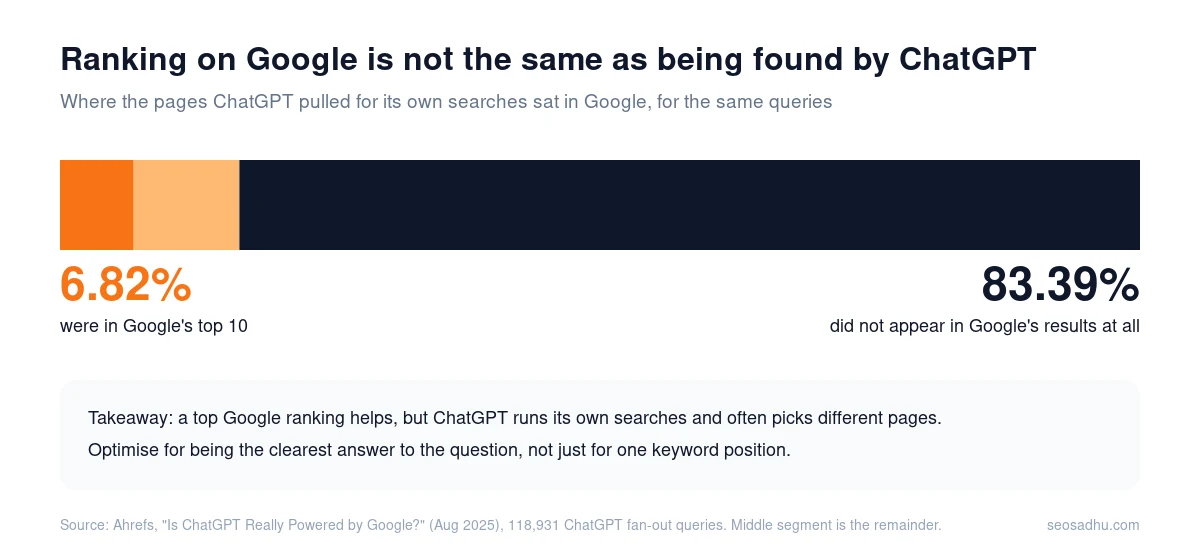
Many site owners assume a good Google position automatically carries over. The data says otherwise. Ahrefs analysed 118,931 fan-out queries and found that “only 6.82% of ChatGPT search results are in the top 10 of Google’s SERPs”, while 83.39% of the pages it chose did not appear in Google’s results at all for the same queries (Ahrefs).
| Factor | Google SEO | ChatGPT visibility |
|---|---|---|
| What “winning” looks like | A top position on a results page | Being cited as a source or named in the answer |
| Who crawls you | Googlebot | OAI-SearchBot, ChatGPT-User, plus third-party search providers |
| Unit that gets used | The whole page | A passage, fact or list lifted from the page |
| Strongest authority signal | Links and relevance | Clear, sourced facts plus how often trusted sites mention you |
| Freshness | Matters for some queries | Matters a lot: cited URLs skew noticeably newer |
| Measurement | Search Console rankings and clicks | Prompt testing, referral traffic and crawler logs |
Which sites ChatGPT trusts most
It helps to know who you are competing with for citations. In September 2026 data from Ahrefs Brand Radar, Reddit was ChatGPT’s most-cited domain with 16.8% of citations, followed by Wikipedia at 7.0% (Ahrefs). Muck Rack’s analysis of more than 25 million links from ChatGPT, Claude and Gemini found that “earned media accounts for 84% of all AI citations”, and that in its tests ChatGPT cited sources in 96% of responses, averaging five citations each (Muck Rack).
Two lessons follow. First, only about five sources get cited per answer, so the competition for each slot is real. Second, most citations go to pages about brands rather than pages by brands. Your own site matters, but so does what others publish about you.
How to rank your website on ChatGPT: 12 steps
The steps fall into four groups: access (steps 1-3), content (steps 4-8), authority (steps 9-11) and commerce (step 12). Do them roughly in that order. There is no point polishing content that OpenAI’s crawler cannot read.
Step 1: Let OpenAI’s crawlers in
This is the single most important technical step, and the one most often broken by accident. OpenAI runs separate crawlers for separate jobs (OpenAI, Overview of OpenAI Crawlers):
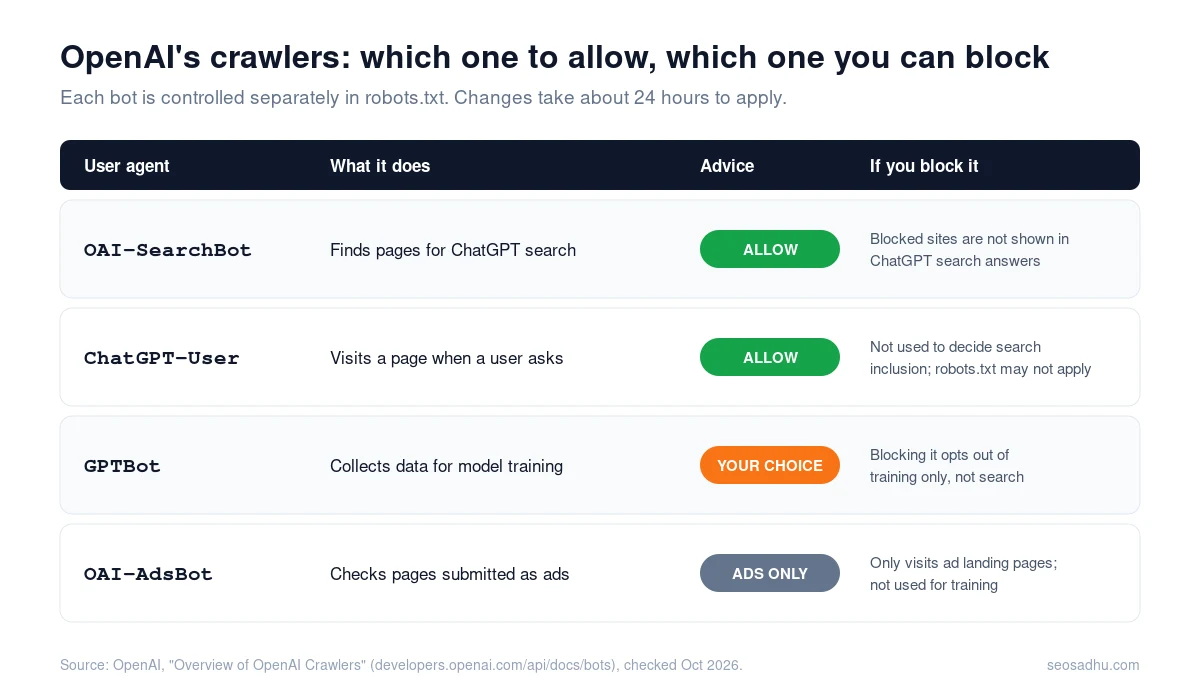
- OAI-SearchBot decides whether you can appear in ChatGPT search. In OpenAI’s words: “Sites that are opted out of OAI-SearchBot will not be shown in ChatGPT search answers, though can still appear as navigational links.”
- ChatGPT-User visits a page when a user asks the assistant to look at it. OpenAI says it “is not used to determine whether content may appear in Search.”
- GPTBot collects content for training. “Disallowing GPTBot indicates a site’s content should not be used in training generative AI foundation models.” Blocking it does not remove you from search.
The settings are independent, so you can allow search and refuse training. A robots.txt that does both looks like this:
# Appear in ChatGPT search
User-agent: OAI-SearchBot
Allow: /

# Let ChatGPT open pages users ask about
User-agent: ChatGPT-User
Allow: /

# Optional: opt out of model training
User-agent: GPTBot
Disallow: /

Sitemap: https://www.example.com/sitemap.xml
Three things to check after you change it:
- Your firewall or CDN. Robots.txt is only half the job. OpenAI’s help centre says to “confirm that the website host or content delivery network allows traffic from OpenAI’s published searchbot IP addresses.” Bot-protection settings on Cloudflare and similar services often block AI crawlers by default. OpenAI publishes the IP ranges at
openai.com/searchbot.json,openai.com/chatgpt-user.jsonandopenai.com/gptbot.json. - Timing. OpenAI notes that “it can take ~24 hours from a site’s robots.txt update for our systems to adjust.”
- Pages you want kept out. Use a
noindexmeta tag rather than a robots.txt block, and leave the page crawlable so the bot can actually read the tag.
Step 2: Get indexed where ChatGPT searches
The assistant draws on third-party search providers as well as its own crawl, so a page that no search index has seen is unlikely to be found. In practice:
- Verify your site in Bing Webmaster Tools and submit your XML sitemap. Microsoft is among the search providers OpenAI’s help centre links to, and Bing’s tools also show crawl errors you might miss in Google Search Console.
- Turn on IndexNow (many SEO plugins, including Rank Math and Yoast, support it) so new and updated pages are announced immediately.
- Keep your Google indexing healthy too. Google is not the source here, but a page that is poorly indexed on Google usually has technical problems that hurt everywhere.
Step 3: Make your pages easy for a bot to read
AI crawlers fetch a lot of pages quickly. The fewer obstacles, the better your odds:
- Serve the main content as HTML. If your text only appears after JavaScript runs, check the raw HTML (View Source, not Inspect). Server-side rendering or static generation is the safest choice.
- Keep pages fast and light. Huge scripts, interstitials and cookie walls that hide content all get in the way.
- Use clean semantic HTML: one H1, logical H2/H3 headings, real lists and tables instead of images of text.
- Do not hide important facts in tabs, accordions loaded by script, or PDFs only. Put the core answer in the page itself.
Step 4: Write answer-first content
AI answers lift passages, not whole pages. The easiest passage to lift is a short, complete answer that makes sense on its own. Open each important section with a direct answer of about 40-60 words, then expand.
| Before (hard to quote) | After (easy to quote) |
|---|---|
| “When it comes to choosing a CRM, there are many factors that businesses should think about, and the right answer really depends on a variety of things, which we will explore in this article.” | “For a 10-person sales team, a CRM should cost under ₹2,000 per user per month, integrate with your email and WhatsApp, and offer a mobile app. HubSpot, Zoho CRM and Freshsales all meet these needs; Zoho is usually the cheapest for Indian teams.” |
The second version names specifics, gives a number and makes a clear claim. It can be quoted without the rest of the article. (The prices are illustrative; always check current pricing before you publish yours.)
Step 5: Structure pages for extraction
- Use question-style headings that match how people phrase prompts: “How much does X cost?”, “Is X better than Y?”, “What is the best X for Y?”
- Use lists for steps and tables for comparisons. They are the formats AI answers most often reproduce.
- Add a short FAQ section covering the follow-up questions people ask next.
- Define terms in one sentence before you explain them.
- Keep one topic per page. A page that tries to answer ten unrelated questions is rarely the best source for any of them.
Step 6: Add statistics, quotations and cited sources
This is the best-evidenced tactic available. The research paper that coined the term generative engine optimization tested nine ways of rewriting web content across 10,000 queries. The authors found that “including citations, quotations from relevant sources, and statistics can significantly boost source visibility, with an increase of over 40% across various queries” (Aggarwal et al., KDD 2024).
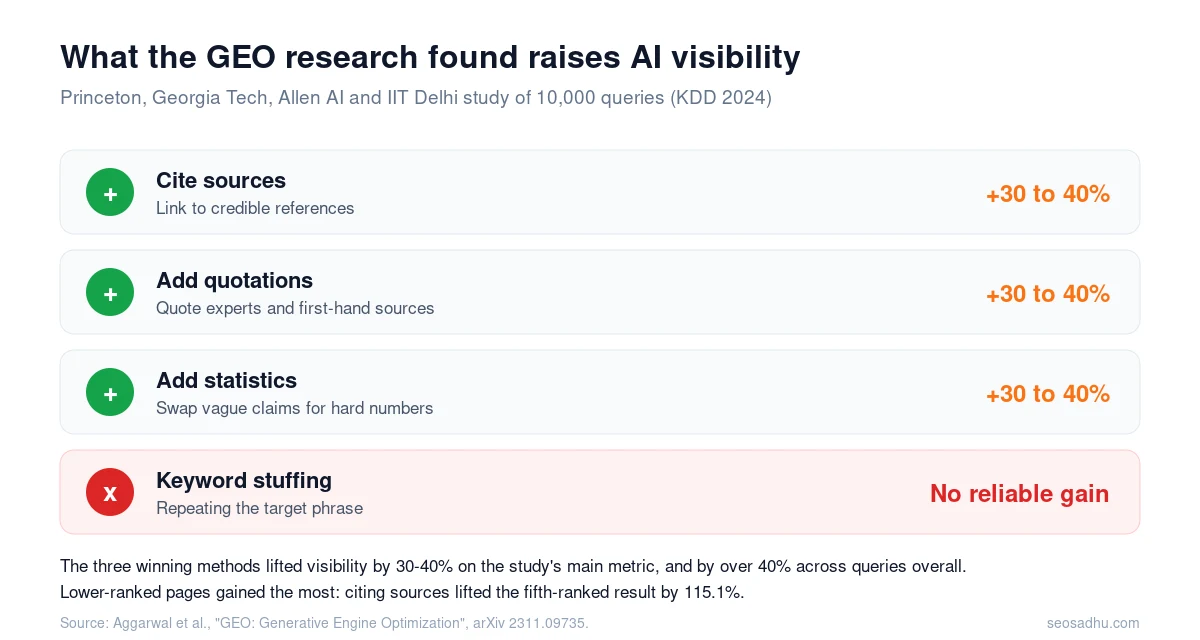
Two more findings from the same paper are worth knowing:
- Keyword stuffing does not work. The authors write that “simple methods like Keyword Stuffing traditionally used in SEO don’t perform well.”
- Smaller sites gain the most. Citing sources lifted the visibility of the fifth-ranked result by 115.1%, while the top-ranked result lost ground. Good sourcing is one of the few levers that helps a smaller site compete with a bigger one.
In practice: replace vague claims (“most customers prefer…”) with specific numbers and their source, quote named experts or customers, and link to the original research rather than to a blog that quoted it.
Step 7: Publish original data and first-hand experience
The model has already seen the generic version of your article many times. What it cannot find elsewhere is your own data and experience. Options that work for most businesses:
- Pricing benchmarks from your own quotes or orders
- Survey results from your customers or community
- Case studies with real before-and-after numbers
- Comparison tests you ran yourself, with the method explained
- Annual “state of the industry” reports for your niche or city
Original data also earns links and mentions from other sites, which feeds step 9.
Step 8: Build topical authority, not one-off posts
A single article on a topic rarely makes you the obvious source. A cluster of pages that covers a subject thoroughly (the main guide, the comparisons, the cost breakdowns, the how-tos and the FAQs, all linked together) gives ChatGPT more chances to find you and more context about what you are an authority on. Map the questions buyers ask at each stage, and make sure each one has a clear, dedicated answer on your site.
Step 9: Earn brand mentions on the sites ChatGPT trusts
Because most AI citations are earned media, what others say about you carries enormous weight. Ahrefs studied 75,000 brands and found that brand web mentions had the strongest correlation (0.664) with brand visibility in Google’s AI Overviews, far ahead of backlinks (0.218) (Ahrefs). That study measured AI Overviews rather than ChatGPT, but the direction is consistent with everything else in this guide: off-site reputation drives AI visibility.
Where to focus:
- “Best X” roundups and comparison articles in your industry. These are exactly the pages AI assistants read when someone asks for recommendations. Ahrefs found that only 32.3% of ChatGPT’s top 1,000 cited pages are realistic outreach targets, so find the ones in your niche and pitch them with something genuinely useful (Ahrefs).
- Digital PR. Original data (step 7) gives journalists a reason to mention you.
- Reddit and forums. Reddit is ChatGPT’s most-cited domain. Take part in genuine discussions where your expertise helps. Disguised self-promotion gets removed and can damage your reputation.
- Wikipedia and Wikidata, only if your organisation genuinely meets notability rules. Never write your own article.
- Podcasts, guest articles, conference talks and industry associations, all of which create mentions on trusted domains.
Step 10: Manage reviews and keep your facts consistent
When an AI assistant recommends a business, it reflects the overall picture it finds. Help it get that picture right:
- Build reviews on the platforms that matter in your sector: Google Business Profile for local businesses, G2 or Capterra for software, Trustpilot or marketplace reviews for e-commerce, and Justdial or industry directories in India.
- Respond to negative reviews professionally. Unanswered complaints become part of the story.
- Keep your brand name, description, founding year, locations, prices and services identical everywhere: your website, social profiles, directories and LinkedIn. Conflicting facts make you harder to describe confidently.
- Add Organization schema with
sameAslinks to your official profiles. OpenAI has not said it uses schema for ranking, but structured data removes ambiguity about who you are and costs little.
Step 11: Keep content fresh and visibly dated
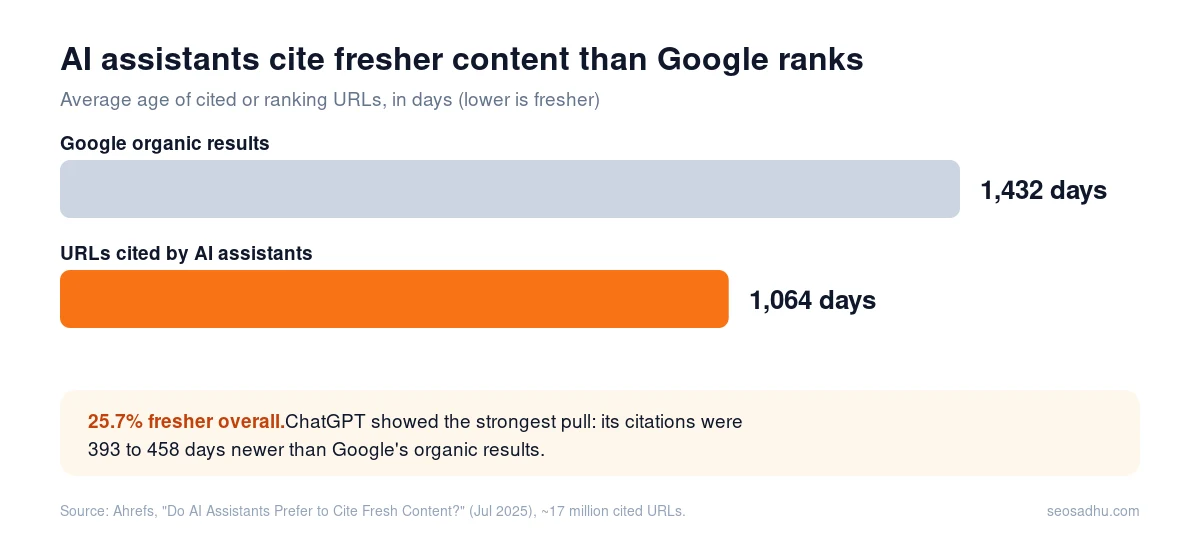
Freshness is one of the clearest patterns in AI citations. Ahrefs analysed about 17 million cited URLs and found that AI assistants cite content that is 25.7% fresher than what ranks in Google’s organic results. ChatGPT showed the strongest preference, citing URLs 393 to 458 days newer than Google’s organic results (Ahrefs).
- Review your most important pages at least every quarter, and immediately when prices, specifications or regulations change.
- Show a visible “last updated” date and keep
dateModifiedin your schema accurate. - Make real updates: new data, new examples, removed outdated advice. Changing the date without changing the content is pointless.
Step 12: If you sell products, get into ChatGPT shopping
For product questions, the assistant can show product results with prices and merchants. OpenAI says “Product results are organic and unsponsored, ranked purely on relevance to the user” (OpenAI). According to its shopping help article, “Merchants are ranked based on factors like availability, price, quality, and whether they are the maker or primary seller of that item” (OpenAI).
- Product feeds give you control. OpenAI’s merchant page says a feed is not required if OpenAI already crawls your site, but “feeds give you greater control over how your products appear.” Feeds are CSV or JSON files, refreshed regularly (ChatGPT for merchants).
- Shopify and Etsy stores are already integrated, so those merchants do not need to apply separately.
- Check availability for your market. OpenAI’s merchant page currently says shopping “is currently live for ChatGPT users in the U.S.” Indian and other merchants should still keep product pages crawlable, priced and in stock, because ChatGPT can also read product information from the web.
- Check the direction of travel. OpenAI launched Instant Checkout in September 2025 and is now “moving away from a standalone Instant Checkout experience” in favour of better discovery and merchant-owned checkout. Product data quality is what matters most.
How to track your ChatGPT visibility
There is no Search Console for this, so you combine four signals.
1. Referral traffic in Google Analytics 4
OpenAI’s publisher guidance stated that “ChatGPT automatically includes the UTM parameter utm_source=chatgpt.com in referral URLs.” In GA4:
- Go to Reports, Acquisition, Traffic acquisition.
- Change the dimension to Session source / medium and search for
chatgpt.com. - To see all AI assistants together, build an exploration with a regex filter on session source, for example:
.*(chatgpt|openai|perplexity|gemini|copilot|claude|meta.ai).*Compare engagement and conversion rate for this segment with your organic traffic. That comparison is usually what convinces a leadership team that AI visibility deserves budget.
2. Crawler activity in your server logs
Search your access logs (or your CDN’s bot analytics) for OAI-SearchBot and ChatGPT-User. Regular OAI-SearchBot visits confirm you are reachable. ChatGPT-User visits show pages that real users asked ChatGPT to open. A sudden drop to zero usually means a firewall rule is blocking them.
3. Monthly prompt testing
Write 25-50 questions your buyers would genuinely ask, from broad (“best digital marketing agency in Bangalore”) to specific (“which agency helps SaaS companies with AI search?”). Run them in ChatGPT every month, ideally logged out or in a temporary chat, and record:
- whether your brand is mentioned, and in what position;
- whether your site is cited, and which page;
- which competitors and sources appear instead;
- whether what it says about you is accurate.
Answers vary from run to run, so look at the trend across many prompts rather than any single answer.
4. AI visibility tools
Dedicated tools automate prompt tracking at scale. They differ in price and in which assistants they cover, so trial one before committing.
| Tool | What it helps with | Cost |
|---|---|---|
| Google Analytics 4 | ChatGPT and other AI referral traffic and conversions | Free |
| Bing Webmaster Tools | Indexing, sitemaps, crawl errors and IndexNow | Free |
| Server logs or CDN bot analytics | OAI-SearchBot and ChatGPT-User activity | Usually free |
| Ahrefs Brand Radar | Brand mentions and citations across AI assistants | Paid |
| Semrush AI SEO tools | AI visibility tracking alongside traditional SEO | Paid |
| Profound | Enterprise AI visibility and citation analytics | Paid |
| Peec AI, Otterly.AI, Mentionlytics | Prompt tracking and brand monitoring for smaller teams | Paid, lower entry price |
| Rank Math or Yoast | Schema, sitemaps and IndexNow on WordPress | Free and paid plans |
A 90-day plan to rank your website on ChatGPT
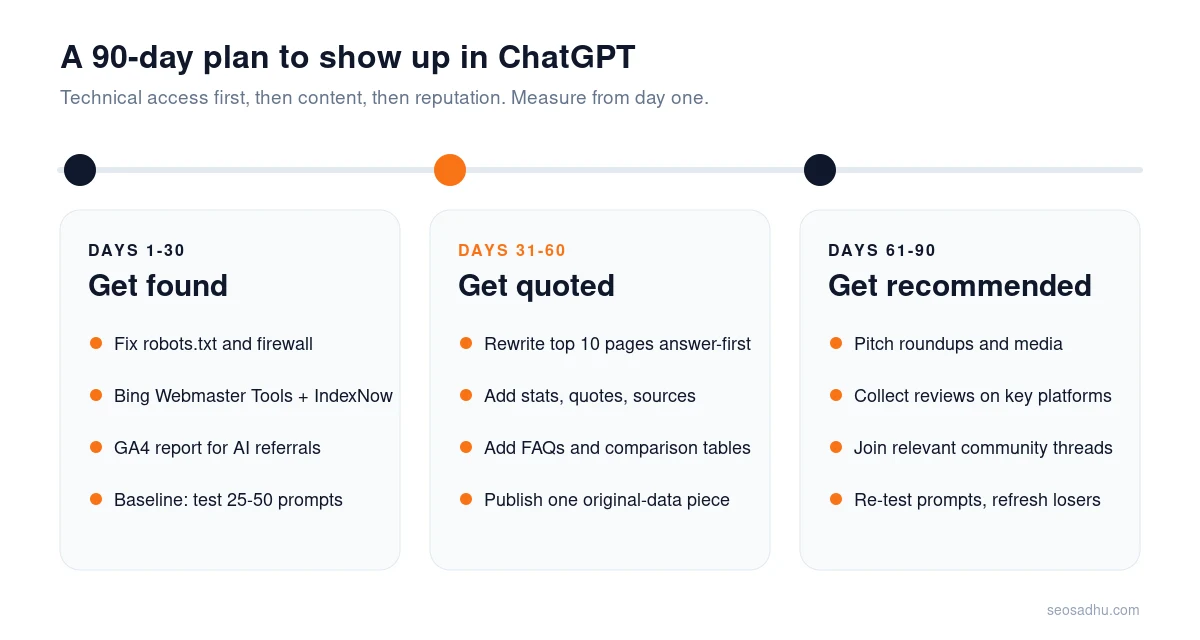
Days 1-30: get found. Fix robots.txt and firewall rules, verify Bing Webmaster Tools, turn on IndexNow, set up the GA4 AI-referral report, and record a baseline by testing your prompt list.
Days 31-60: get quoted. Rewrite your ten most important pages answer-first. Add statistics, quotations and sources. Add FAQs and comparison tables, and publish one piece built on original data.
Days 61-90: get recommended. Pitch the roundups and publications that get cited in your niche, collect reviews on the platforms that matter, take part in relevant community discussions, then re-run your prompt tests and refresh the pages that are not being cited.
Expect gradual movement rather than a switch flipping. Search-based citations can change within weeks once pages are crawled; what the model says from training data changes much more slowly.
Myths and mistakes that waste time
| Myth | Reality |
|---|---|
| “Blocking GPTBot keeps me out of ChatGPT.” | GPTBot is for training. OAI-SearchBot controls search visibility. Block the wrong one and you vanish from answers. |
| “An llms.txt file will get me cited.” | OpenAI has published no guidance saying it uses llms.txt for search. It is harmless, but it is not a ranking lever. |
| “ChatGPT ads will boost my organic mentions.” | OpenAI says ads run on separate systems and do not influence answers. |
| “Repeating my keyword will help.” | The GEO research found keyword stuffing did not perform well. |
| “If I rank #1 on Google, I’m covered.” | Only 6.82% of the pages it pulled were in Google’s top 10 in Ahrefs’ study. |
| “Hidden text or instructions can make AI recommend me.” | Prompt-injection tricks are manipulative, risky and likely to backfire. Earn the mention instead. |
| “AI-generated content at scale will flood ChatGPT with my pages.” | Generic content adds nothing the model has not already seen. Original data and expertise are what get cited. |
Watch: how ChatGPT search works
OpenAI’s own walkthrough from the day search reached all users shows how search results, sources and links appear inside answers.
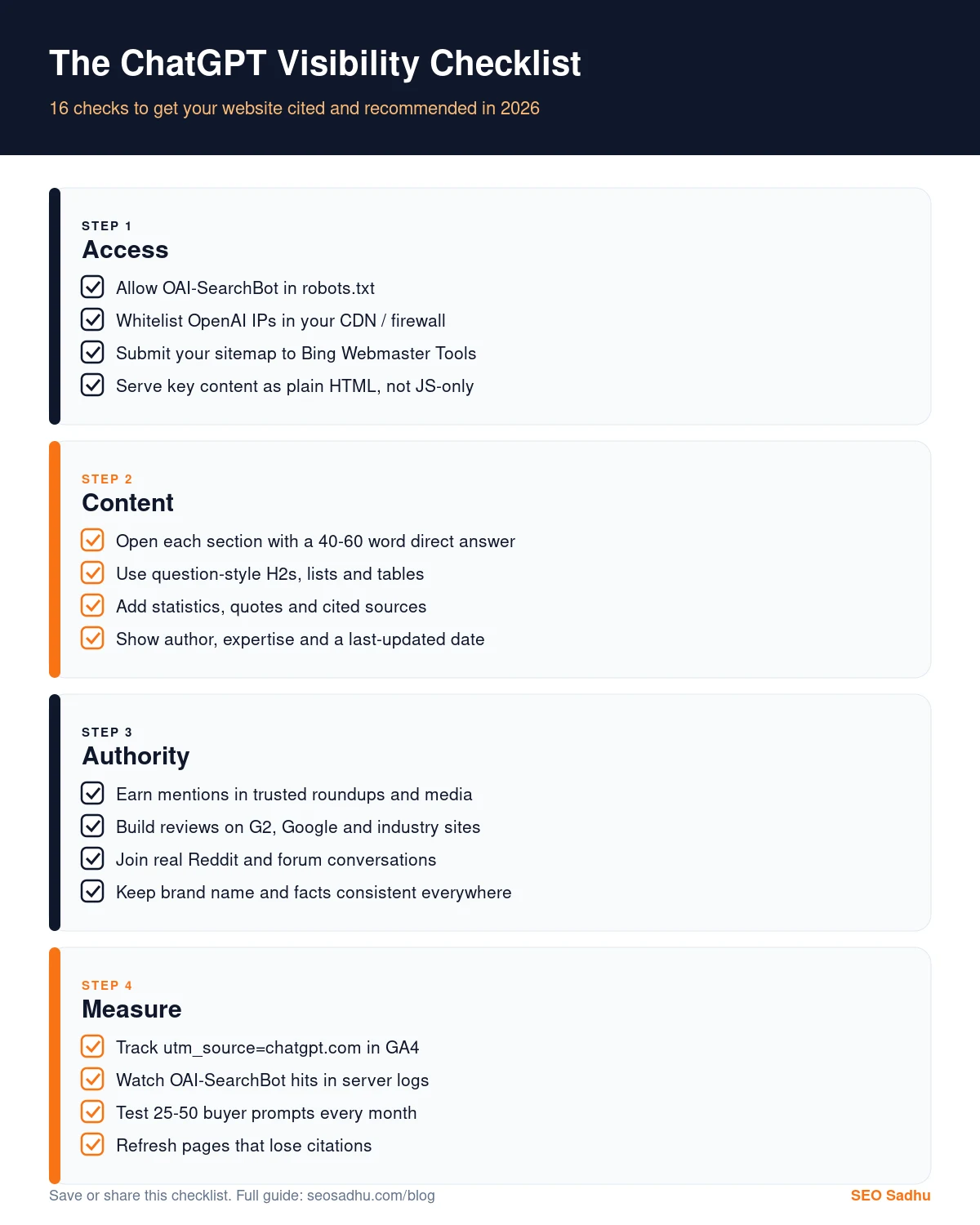
The ChatGPT visibility checklist
Save this checklist, share it with your team, and work through it one group at a time.
Frequently asked questions
Can I pay to rank on ChatGPT?
No. Ads are now shown to some users, but OpenAI says ads run on separate systems and advertisers have no ability to shape, rank or alter ChatGPT’s responses. Organic citations and recommendations cannot be bought.
How long does it take to show up in ChatGPT?
Technical fixes such as unblocking OAI-SearchBot take effect within about a day of the robots.txt change, according to OpenAI. Being cited depends on your pages being crawled and chosen, which usually takes weeks. Changing what ChatGPT says about your brand from its training data takes longer, because it depends on future model updates.
Does Google SEO still matter for ChatGPT?
Yes, but it is not enough on its own. The technical health, content quality and authority that help you on Google also help on ChatGPT. However, ChatGPT runs its own searches, and in one Ahrefs study only 6.82% of the pages it pulled were in Google’s top 10.
Should I block GPTBot?
That is a business decision. Blocking GPTBot stops your content being used to train OpenAI’s models, but it does not remove you from ChatGPT search, which is controlled by OAI-SearchBot. Many businesses allow OAI-SearchBot and ChatGPT-User while blocking GPTBot.
Does schema markup help me rank on ChatGPT?
OpenAI has not said that ChatGPT search uses schema.org markup to rank web pages. Organization, Product, FAQ and Article schema still help by making your facts unambiguous, and product data clearly matters for ChatGPT shopping.
How do I know if ChatGPT sends me traffic?
In Google Analytics 4, look for the source chatgpt.com in your traffic acquisition report. OpenAI’s publisher guidance said ChatGPT adds utm_source=chatgpt.com to referral links. Your server logs will also show visits from OAI-SearchBot and ChatGPT-User.
Can a small business or local business rank on ChatGPT?
Yes. The GEO research found that lower-ranked sites gained the most from citing sources, quotations and statistics. Local businesses should also keep their Google Business Profile, directory listings and reviews accurate and consistent, because these shape how ChatGPT describes local options.
Is optimising for ChatGPT the same as GEO or AEO?
Broadly, yes. Generative engine optimization (GEO) and answer engine optimization (AEO) both describe making your content easy for AI systems to find, trust and quote. ChatGPT is the biggest of these systems, but the same work also helps with Gemini, Perplexity, Copilot and Google’s AI Overviews.
Final thoughts
Learning how to rank your website on ChatGPT is less about tricks and more about being the clearest, best-sourced and most talked-about answer in your field. Open the door to OAI-SearchBot, write pages that answer questions directly with real numbers, keep them fresh, and earn mentions on the sites ChatGPT already reads. Then measure what changes and keep improving.
If you would like a second pair of eyes, SEO Sadhu can audit how your website appears in ChatGPT today, check your crawler access, and build a plan that covers both Google and AI search. You can also read our take on the pros and cons of using ChatGPT for SEO, or see our SEO services and content writing services.
Sources
- OpenAI, Overview of OpenAI Crawlers (checked October 2026)
- OpenAI, Introducing ChatGPT search (31 October 2024, updated February 2025)
- OpenAI Help Center, Searching the web with ChatGPT
- OpenAI, Publishers and Developers FAQ (archived 4 October 2026)
- OpenAI, weekly reach of 1.2 billion people (5 October 2026); earlier figures from OpenAI posts dated 31 March 2025, 15 September 2025, 27 February 2026 and 31 August 2026
- OpenAI Help Center, Ads in ChatGPT
- OpenAI, Buy it in ChatGPT (29 September 2025); ChatGPT for merchants; Shopping with ChatGPT search
- Aggarwal et al., GEO: Generative Engine Optimization, KDD 2024
- Ahrefs, Is ChatGPT really powered by Google? (August 2025)
- Ahrefs, Do AI assistants prefer to cite fresh content? (July 2025)
- Ahrefs, AI Overview brand correlation study (updated April 2026)
- Ahrefs, Most cited domains in ChatGPT (September 2026 data) and ChatGPT’s most cited pages (October 2025)
- Ahrefs, AI traffic study and AI search traffic conversions
- Muck Rack, What is AI reading? (May 2026)
- Similarweb, AI referral traffic by industry (September 2026)
- Seer Interactive, How traffic from ChatGPT converts (June 2025)
- Semrush, AI search SEO traffic study (June 2025)
- Pew Research Center, Americans and AI 2026 (June 2026)
- Gartner, Search engine volume will drop 25% by 2026 (February 2024)
Last updated: 16 October 2026. We review this guide whenever OpenAI changes how ChatGPT search works.