
Shopify Plus powers some of the world’s fastest-growing D2C and omnichannel retail brands. Its checkout reliability, payment ecosystems, and hosting scalability are unmatched. However, for enterprise brands managing catalogs with tens of thousands of SKUs, Shopify’s rigid native SEO architecture creates structural bottlenecks—from duplicate product URL generation to locked taxonomy paths and unmanaged filter parameter bloat.
- The Duplicate URL Architecture: By default, Shopify themes link internal collection pages to duplicate URLs (
/collections/mens/products/jacket) instead of canonical roots (/products/jacket), diluting internal link equity across millions of crawl paths. - Rigid URL Taxonomy: Shopify prohibits true nested sub-folders (e.g.,
/clothing/mens/jackets/). Enterprise brands must overcome this via virtual breadcrumb schema and intelligent collection cross-linking. - International Expansion Strategy: Deciding between Shopify Markets (subfolder routing) versus discrete regional multi-store instances dictates your international hreflang stability, currency handling, and localized search visibility.
The 4 Major Shopify Architecture Bottlenecks & Solutions
1. The Collection-Product Internal Linking Trap
In standard Shopify Liquid theme templates, clicking a product from a category page routes the user to a collection-nested URL:
- Internal Link Path:
example.com/collections/leather-shoes/products/oxford-shoe - Canonical Tag:
example.com/products/oxford-shoe
While Shopify includes a canonical tag pointing back to the root product URL, Google is forced to crawl and process millions of duplicate collection paths. This exhausts crawl budget and dilutes internal PageRank flow.
In your theme’s product-grid-item.liquid (or card-product.liquid), locate {{ product.url | within: collection }} and strip the filter to simply {{ product.url }}. This ensures all category cards link directly to your canonical product URLs, consolidating 100% of internal PageRank onto your primary money pages.
2. Faceted Navigation and Filter Parameter Bloat
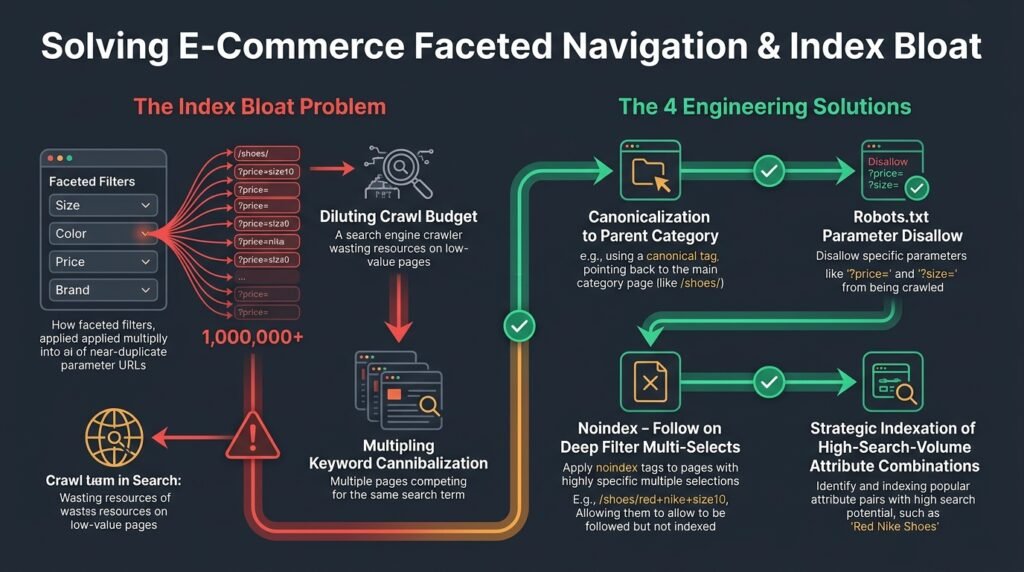
Enterprise fashion and electronics catalogs feature extensive filter attributes: size, color, brand, material, and price. When apps like Search & Discovery or third-party filter plugins generate unique URLs for every filter selection (e.g., ?filter.v.price.gte=50&filter.v.m.custom.color=Black), Google indexes hundreds of thousands of low-value, duplicate product listings.
| Filter Type | SEO Value & Search Demand | Technical Strategy |
|---|---|---|
| High-Demand Attributes (e.g., “Men’s Black Leather Jackets”) | High commercial search volume. | Create a standalone, indexable collection page with unique H1 and custom copy. |
| Multi-Select Filters (e.g., Size + In-Stock + Sorting) | Zero external search volume (UX only). | Canonicalize to base collection; use AJAX state updates without generating indexed URLs. |
| Dynamic Price Range Parameters | Zero value; causes massive crawl bloat. | Disallow parameter crawling in robots.txt.liquid via clean disallow rules. |
3. Scaled E-Commerce Structured Data Schema
To win Google Merchant Center badges, Rich Snippets, and star ratings across organic search, enterprise Shopify stores must deploy clean, automated JSON-LD structured data including:
- Product & Offer Schema: Dynamic mapping of real-time inventory (
InStockvs.OutOfStock), pricing, price currency, and SKU/GTIN codes. - Merchant Return Policy & ShippingDetails: Explicit schema markup detailing return windows and delivery costs to capture Google’s trusted store badges.
- AggregateRating Schema: Integrating verified customer review apps (Yotpo, Okendo, Stamped) directly into native schema without render lag.
4. International SEO: Shopify Markets vs. Multi-Store Architecture
When expanding globally, enterprise brands must choose their international infrastructure:
- Shopify Markets (Subfolders): Consolidates domain authority under a single domain (e.g.,
example.com/en-gb/). Ideal for fast expansion where backlink authority can be shared globally. - Multi-Store (ccTLDs / Separate Instances): Dedicated separate stores (e.g.,
example.co.uk,example.de). Essential when regional pricing, localized product catalogs, or legal entities vary significantly between jurisdictions.
Unlock Enterprise Organic Scale on Shopify Plus
At SEO Sadhu, we specialize in overcoming Shopify’s native architecture constraints. We optimize Liquid templates, clean parameter bloat, scale product schema, and drive millions in organic catalog revenue for leading D2C brands.
Frequently Asked Questions (FAQ)
Can we change Shopify’s default /collections/ and /products/ URL prefixes?
No. Shopify’s core architecture enforces these prefixes, and they cannot be removed on standard or Shopify Plus hosted stores. However, you can achieve world-class rankings by optimizing internal linking, using clean handle slugs, and implementing structured breadcrumb schema.
Can we edit the robots.txt file on Shopify?
Yes. Shopify allows merchants to edit their robots.txt file by creating a robots.txt.liquid template in their theme. This allows you to add custom disallow directives, block parameterized search URLs, and manage crawler access cleanly.
How should out-of-stock products be handled on Shopify?
Never unpublish or delete an out-of-stock product page if it has earned backlinks or historical organic rankings. Keep the page live, update the schema status to OutOfStock, offer an email restock notification form, and dynamically showcase related in-stock items to prevent bounce rates.