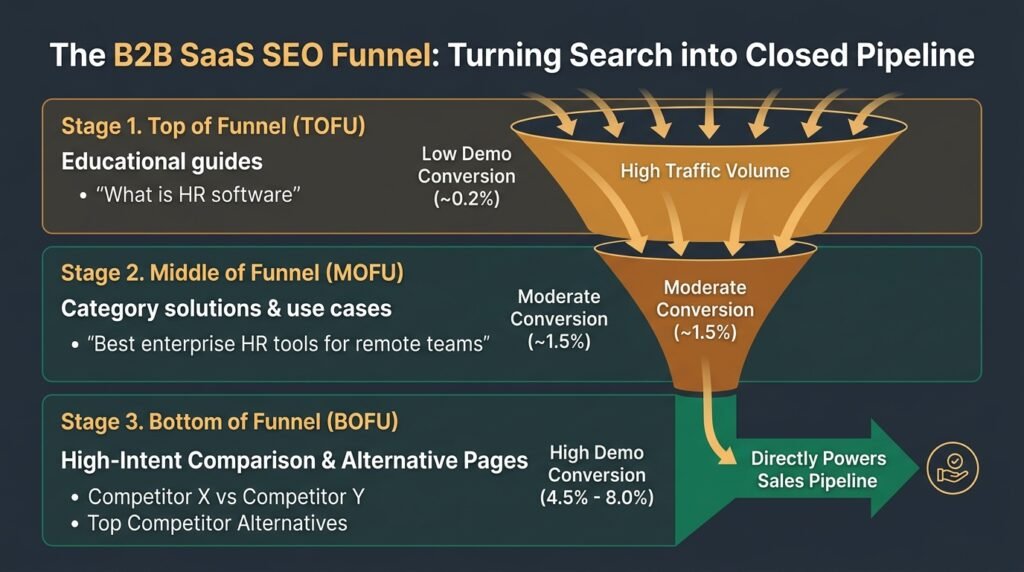
Most marketing departments spend 80% of their content budget on top-of-funnel educational articles that take nine months to nurture into a pipeline lead. Meanwhile, their most lucrative potential customers are actively searching for software alternatives, vendor comparisons, and commercial pricing models. A disciplined Bottom-of-Funnel (BOFU) SEO Strategy captures buyers at the exact moment they have their credit card or corporate purchase order in hand.
- The Conversion Velocity Advantage: BOFU search queries typically register conversion rates between 8% and 20%—up to 40x higher than top-of-funnel blog traffic.
- Intercepting Competitor Churn: Searches containing “[Competitor] alternatives” or “[Competitor] pricing” represent dissatisfied customers actively shopping for a replacement platform right now.
- The Objective Comparison Model: Modern enterprise buyers reject biased sales propaganda. High-converting comparison pages win by providing honest, balanced feature breakdowns that objectively highlight where each solution excels.
The 5 Core BOFU Content Archetypes
To dominate high-intent commercial search, structure your organic program around five proven bottom-of-funnel formats:
| BOFU Content Format | Target Search Pattern | Buyer Mindset & Conversion Trigger |
|---|---|---|
| 1. Competitor Alternative Pages | “[Competitor] alternatives for enterprise” | Frustrated by competitor pricing or poor support; seeking a superior alternative immediately. |
| 2. Head-to-Head Comparison | “[Your Brand] vs [Competitor]” | Down to the final two vendors on their procurement shortlist; needs technical proof. |
| 3. Niche Industry Solutions | “Best [Software] for [Specific Vertical]” | Requires specialized compliance, integrations, or workflows unique to their exact industry. |
| 4. Transparent Pricing & TCO | “[Category] cost & implementation guide” | CFO/Finance team modeling budget allocations; ready to approve commercial spend. |
| 5. Migration & Switching Guides | “How to migrate from [Legacy Tool] to [New]” | Fears technical downtime; needs frictionless data transfer assurances to finalize switch. |
How to Win the Competitor Comparison SERP Ethically
Many marketing leaders hesitate to publish competitor comparison pages, fearing legal pushback or brand degradation. When executed with journalistic rigor and fairness, comparison hubs become your most respected assets:
1. Acknowledge Competitor Strengths Honestly
If your comparison page claims your platform is better at literally everything, modern buyers dismiss it as self-serving propaganda. Win immediate credibility by explicitly stating where competitors excel (e.g., “If you are a small startup with under 5 employees, Competitor X is a great lightweight option. However, if you require multi-region compliance and custom API limits, our enterprise architecture is built for you.”).
2. Base Claims on Verified Third-Party Data
Protect your brand legally by citing independent review scores from G2, Capterra, Gartner, and Trustpilot. Rather than making unsubstantiated claims, quote customer satisfaction ratings and feature benchmark scores directly.
3. Embed Seamless Switching Paths
Do not just ask the user to request a demo. Remove the friction of switching by offering Free Migration Services or dedicated automated data import tools (e.g., “One-click CSV/API import from Competitor X in under 15 minutes.”).
Capture High-Intent Commercial Buyers Today
At SEO Sadhu, we build high-converting Bottom-of-Funnel search hubs for high-growth tech companies and enterprise service providers. We capture buyers actively comparing vendors and turn them into closed-won revenue.
Frequently Asked Questions (FAQ)
Is it legal to use a competitor’s trademarked name in SEO comparison pages?
Yes, in most jurisdictions (including the US, UK, and India), fair-use doctrine permits the use of a competitor’s trademark for comparative advertising, provided the comparison is truthful, accurate, non-misleading, and does not cause consumer confusion regarding product origin.
Why do keyword tools show low search volume for BOFU queries?
Third-party keyword tools often underestimate long-tail and comparative search volumes. More importantly, 150 searches a month from decision-makers ready to spend $50,000 is infinitely more valuable than 10,000 monthly searches from students researching definitions.
How should we structure our comparison page URLs?
Keep URLs clean and intuitive: /compare/competitor-name/ or /versus/competitor-name/. Group all comparative content under a dedicated parent directory to build focused topical authority.