
It is the ultimate paradox of digital marketing: your website ranks on page one of Google for dozens of competitive keywords, your analytics dashboard showcases upward-sloping organic traffic curves, yet your sales pipeline remains bone dry and inbound demos are non-existent. High keyword rankings and massive session counts mean nothing if your organic search architecture fails to convert casual visitors into paying customers.
- The Informational Vanity Trap: Many agencies inflate traffic metrics by ranking for broad, definition-level queries (e.g., “what is workflow automation”) that attract students, job seekers, and researchers with zero purchasing authority.
- The “Premature Demo” Ask: Demanding an enterprise buyer commit to a 30-minute sales demonstration on their very first blog visit creates massive conversion friction. Successful funnels deploy low-commitment micro-conversions.
- The Trust Deficit: If your landing pages lack immediate third-party validation (G2 badges, customer case studies, client logos, transparent pricing indicators), high-intent buyers bounce back to search competitors within eight seconds.
Keyword Intent vs. Commercial Conversion Reality
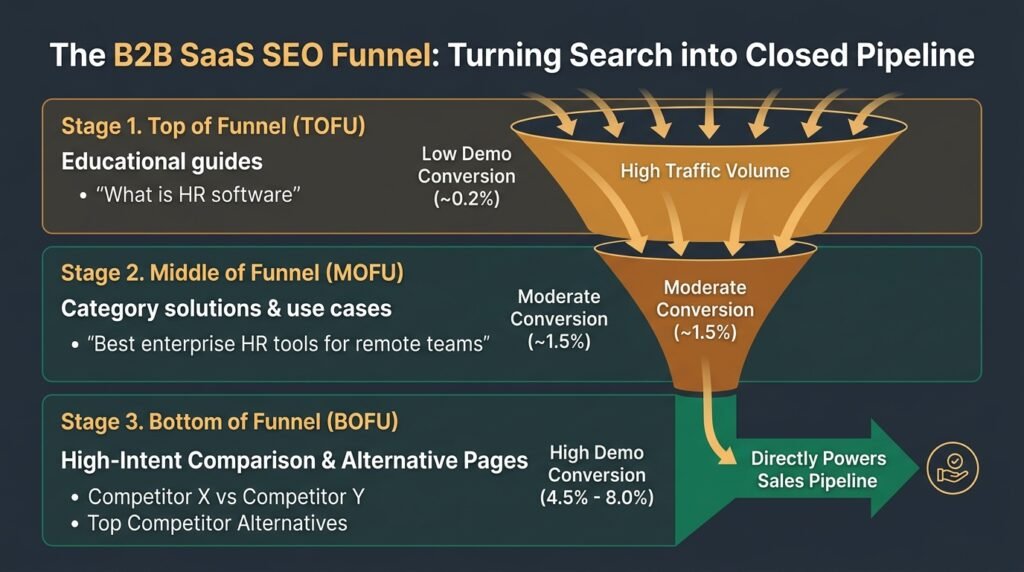
Traffic is not uniform. The intent underlying a search query dictates whether a visitor represents viable commercial pipeline:
| Search Intent Tier | Example Query | Typical Conversion Rate | Commercial Pipeline Value |
|---|---|---|---|
| Top-of-Funnel (TOFU) | “history of project management methodologies” | < 0.1% | Zero (Vanity traffic only). |
| Middle-of-Funnel (MOFU) | “how to automate client onboarding workflows” | 1.0% – 2.5% | Moderate (Requires nurture workflows). |
| Bottom-of-Funnel (BOFU) | “best client onboarding software for accounting firms” | 8.0% – 15.0%+ | Massive (Immediate qualified pipeline). |
The 5 Primary Culprits Behind the Revenue Disconnect
1. Keyword Cannibalization on Educational Queries
Most corporate blogs are packed with general definitions written for beginner audiences. When an agency targets “what is SEO” or “cloud computing benefits”, 95% of visitors have zero budget, zero decision-making power, and zero intent to purchase. Reallocate 70% of your editorial bandwidth to comparative, transactional, and vendor selection terms.
2. The Rigid “One-Size-Fits-All” CTA Strategy
Placing an aggressive red button that screams “Book an Enterprise Demo” on an educational blog post is the digital equivalent of proposing marriage on a first date. Visitors reading an industry guide need a logical next step:
- Offer a Free Downloadable Audit Checklist or Excel calculator in exchange for a business email.
- Embed interactive interactive tools (e.g., ROI calculators, technical assessments) directly in the body copy.
- Reserve high-friction sales demo forms for dedicated product landing pages and competitor comparison matrices.
3. Form Friction and Qualification Overkill
Marketing teams often kill their own conversions by demanding that visitors fill out twelve mandatory fields (Phone number, Company revenue, Employee count, Job title, Timeline). Every unnecessary form field reduces conversion velocity by up to 14%. Keep initial capture forms to Email, Name, and Company Website, and enrich company data automatically in the background using tools like Clearbit or Apollo.
4. The Absence of Above-the-Fold Social Proof
B2B enterprise buyers are naturally risk-averse. If a visitor lands on your page and sees zero customer logos, no G2 or Trustpilot badges, and no verified client quotes in the opening viewport, they immediately assume you are an unvetted startup. Prominently display customer trust signals within the first 600 pixels of the page.
5. Mobile Experience Friction & Broken Layouts
Over 55% of enterprise decision-makers initially research vendors on mobile devices while commuting or between meetings. If your navigation overlays cover the screen, forms fail to auto-fill on iOS keyboards, or tap targets are clustered too tightly, high-value prospects bounce immediately to a competitor with a cleaner mobile experience.
Transform Your Organic Traffic into Inbound Sales
At SEO Sadhu, we specialize in Revenue-First Search Marketing. We audit your entire organic funnel—from keyword intent mapping to conversion rate optimization—turning existing search rankings into qualified sales calls and signed contracts.
Frequently Asked Questions (FAQ)
What is considered a healthy organic conversion rate for B2B websites?
For general blog traffic, a healthy lead conversion rate (form fills, resource downloads) ranges between 1.5% and 3.0%. For dedicated bottom-of-funnel commercial landing pages (pricing, comparisons, product solutions), conversion rates should consistently achieve between 6.0% and 12.0%+.
Should we prune or delete blog posts that generate traffic but zero leads?
Do not delete pages that earn legitimate backlinks or contribute to domain topical authority. Instead, optimize them by inserting contextual internal links pointing to your high-converting commercial pages and adding high-value lead magnets tailored to that specific topic.
How quickly can conversion rate optimization (CRO) improve organic sales?
Unlike ranking improvements which require weeks of indexing, CRO improvements take effect immediately upon deployment. Fixing form friction, improving value propositions, and aligning call-to-actions often doubles inbound lead volume within the first 14 days without needing a single new visitor.