
Operating a brand with 10, 50, or 200+ physical branches across multiple cities presents a unique search engine challenge. While single-location businesses focus on one Google Business Profile, multi-location enterprises must systematically dominate local 3-packs across dozens of competitive geographic territories simultaneously.
⚡ Key Takeaways: Multi-Location Local Dominance
- Ban “Mad Libs” City Pages: Creating identical city landing pages where only the city name is swapped triggers doorway page penalties and zero organic engagement.
- Synchronize 1-to-1 GBP Connections: Every Google Business Profile must link directly to its corresponding unique local branch landing page—never dump all listings to the homepage.
- Implement Nested LocalBusiness Schema: Provide search engines with exact geo-coordinates, operating hours, and branch telephone numbers using structured JSON-LD markup.
- Prepare for Conversational Queries: Mobile searchers increasingly use voice prompts like “best clinic near me open now.” Structure content to capture mobile voice search citations.
- Audit Technical Foundations: Ensure multi-location directories load under 2.5 seconds by verifying our master technical SEO checklist.
At SEO Sadhu, we manage multi-location search campaigns for retail chains, financial institutions, and healthcare networks. Scaling local visibility requires establishing clean architectural hierarchies that earn algorithmic trust in every zip code.
1. The Four Pillars of Multi-Location SEO Dominance
Dominating Google’s Local Map Pack across multiple cities requires harmonizing off-page listings with on-page technical landing page architecture.

Follow our four-pillar framework below to capture regional market share:
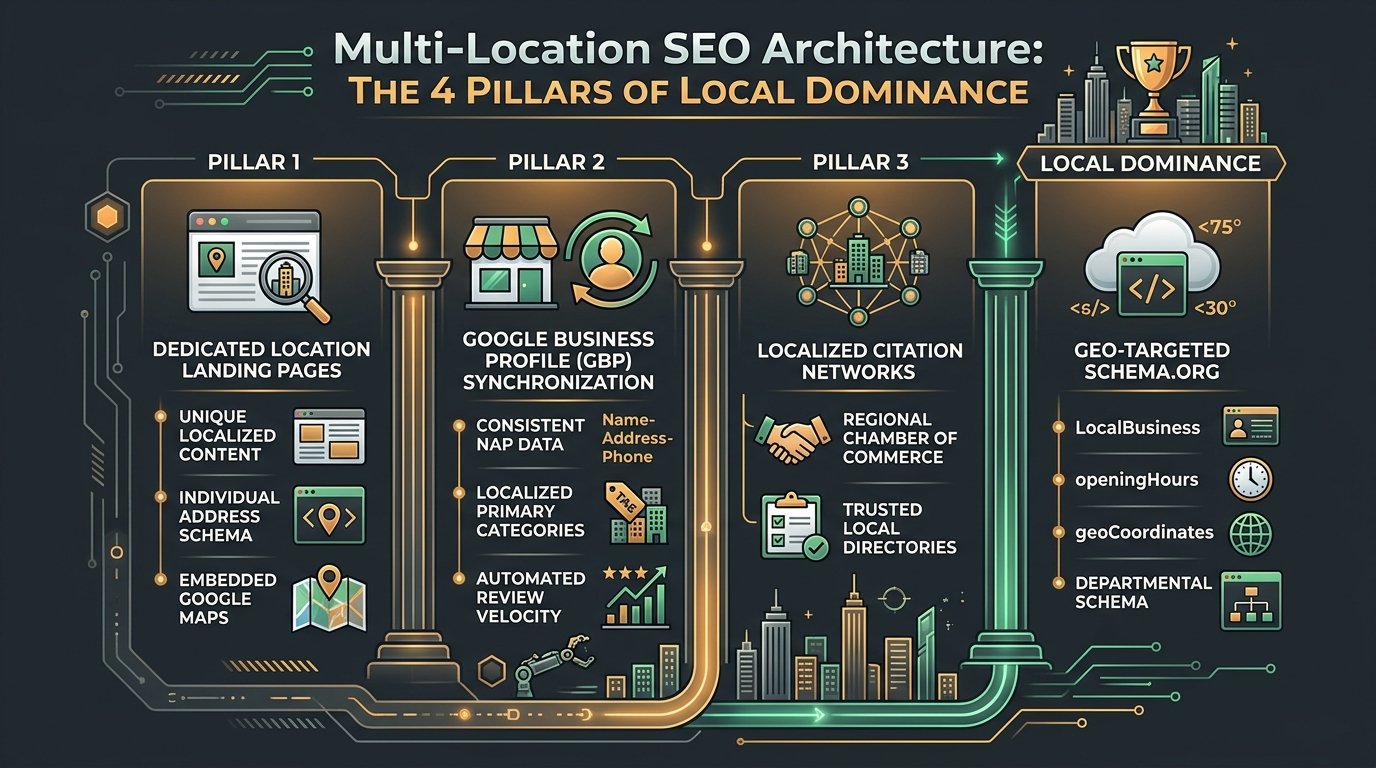
2. Pillar 1: Dedicated, High-Value Location Landing Pages
Google evaluates your website to verify the legitimacy of your Google Business Profiles. If your location pages contain thin, boilerplate text, your map rankings will suffer.
Every branch landing page must feature distinct, localized content assets:
- Individual Branch Details: Exact street address, local direct-dial phone number, and specific branch opening hours.
- Local Team & Staff Introductions: Photographs and professional bios of the branch manager or local specialists operating that physical facility.
- Localized Customer Testimonials: Reviews submitted specifically by customers from that neighborhood, complete with project descriptions.
- Interactive Google Maps Embed: A responsive embedded map pointing directly to that specific verified Google Business Profile.
Reviewing our location-specific expertise across premier hubs like SEO specialists in Varanasi and top SEO agencies in Bangalore demonstrates how localized relevance drives real-world foot traffic.
3. Pillar 2: Google Business Profile (GBP) Synchronization
Managing dozens of Google Business Profiles manually leads to data drift and inconsistent information. Discrepancies in your business Name, Address, or Phone number (NAP) confuse Google’s local ranking algorithms.
Maintain strict synchronization across your profile portfolio:
- Bulk Verification: Utilize Google’s bulk location verification program if your enterprise manages 10 or more physical locations under the same brand name.
- Exact Landing Page Linking: Always set the website link inside each GBP to that location’s specific URL (e.g.,
domain.com/locations/downtown-chicago/) rather than the generic root homepage. - Continuous Review Generation: Deploy automated SMS or email review requests post-transaction. Review velocity and localized keyword mentions inside reviews directly impact 3-pack placement.
4. Pillar 3: Clean URL Hierarchy & Breadcrumb Taxonomy
Search engine crawlers need to understand your geographic footprint through logical site taxonomy. Avoid flat, disorganized URL structures.
Structure your multi-location directory using this logical hierarchy:
/locations/                       (Directory Hub)
/locations/california/            (State Hub)
/locations/california/san-diego/  (City / Branch Landing Page)
This breadcrumb hierarchy distributes PageRank authority efficiently from your top-level domain down into individual neighborhood branch pages.
5. Pillar 4: Geo-Targeted JSON-LD Schema Architecture
Structured data provides Google’s Knowledge Graph with mathematical confirmation of your physical presence. Implementing rich schema prevents search engines from mistaking your branches for virtual offices.
Every individual location page must include comprehensive LocalBusiness (or specific sub-types like MedicalClinic, FinancialService, or Store) schema in JSON-LD format:
@type: Highly specific business categoryname: Official location-specific brand nameaddress: PostalAddress matching postal recordsgeo: Exact latitude and longitude coordinatesopeningHoursSpecification: Weekly operating scheduletelephone: Local branch direct phone line
As detailed in our guide on the responsibilities of an SEO manager, technical schema governance ensures zero confusion across search engines and AI assistants.
Whether scaling regional healthcare franchises across India or consulting with national enterprise chains, partnering with vetted experts using our agency selection guide ensures consistent growth.
Frequently Asked Questions About Multi-Location SEO
1. Can multiple business locations share the same phone number?
While toll-free customer service numbers can be listed as secondary contact points, each physical branch should display a distinct local area code telephone number to maximize local algorithmic trust.
2. How do we avoid duplicate content penalties on location pages?
Avoid copying and pasting identical service descriptions. Include unique local customer reviews, specific branch staff bios, localized FAQs, directions from prominent local landmarks, and photos of the actual facility.
3. What should we do if one of our branches moves to a new address?
Update the address in your Google Business Profile first, then update your website’s location page and schema markup. Update major data aggregators (Foursquare, Data Axle) to prevent old address citations from overwriting your profile.
4. How does proximity affect Google Local 3-Pack rankings?
Proximity is a major ranking factor. A user searching on a mobile device will see different local results than someone searching 5 miles away. Strong localized organic links and high review counts expand your ranking radius.
5. Can we create location pages for cities where we do not have a physical office?
You can create service-area landing pages targeting neighboring towns, but you cannot create a Google Business Profile without a verified physical storefront or proof of service-area operation.
6. What is the typical agency cost for managing multi-location SEO?
Multi-location SEO typically ranges from ₹75,000 to ₹2,50,000+ ($1,000 to $3,500+ USD) per month, depending on total branch count, as outlined in our comprehensive SEO pricing guide.
7. Should each location have its own separate website?
No. Creating separate standalone websites for each branch dilutes domain authority. Consolidating all branches under one authoritative root domain creates massive aggregate ranking power.
8. How do we prevent our local rankings from dropping during a website redesign?
Review our website migration SEO checklist. Ensure all historic location page URLs are mapped with 1-to-1 301 redirects and verify that Google Business Profile links are updated immediately.
9. What should we do if our local traffic drops suddenly?
Check for suspended Google Business Profiles, unverified listings, or accidental noindex tags using our diagnostic framework on why organic traffic drops suddenly.
10. How do customer reviews influence multi-location rankings?
High review velocity, positive star ratings, and keywords mentioned organically in customer feedback directly signal relevance and customer satisfaction to Google’s local ranking algorithms.
Dominate Your Local Markets with SEO Sadhu
Scaling physical branch locations requires an enterprise local search strategy that drives foot traffic, phone inquiries, and qualified regional revenue.
At SEO Sadhu, we specialize in multi-location local search architecture, Google Business Profile portfolio management, and localized conversion optimization. Ready to capture map pack dominance across your branches? Contact our multi-location local SEO specialists today to request a comprehensive territory audit.