Most technical SEO audits fail for a simple reason: they obsess over dozens of minor cosmetic warnings while ignoring the architectural bottlenecks that actually stop search engines from indexing revenue-generating pages. When analyzing client websites at SEO Sadhu, we frequently see sites with hundreds of well-written articles that fail to rank simply because an unoptimized JavaScript payload, a broken canonical loop, or an aggressive crawl barrier blocks search engines from ever evaluating the content.
⚡ Key Takeaways for Technical SEO
- Crawlability Precedes Ranking: If search engine bots cannot discover and render your page within their compute budget, on-page optimization is completely useless.
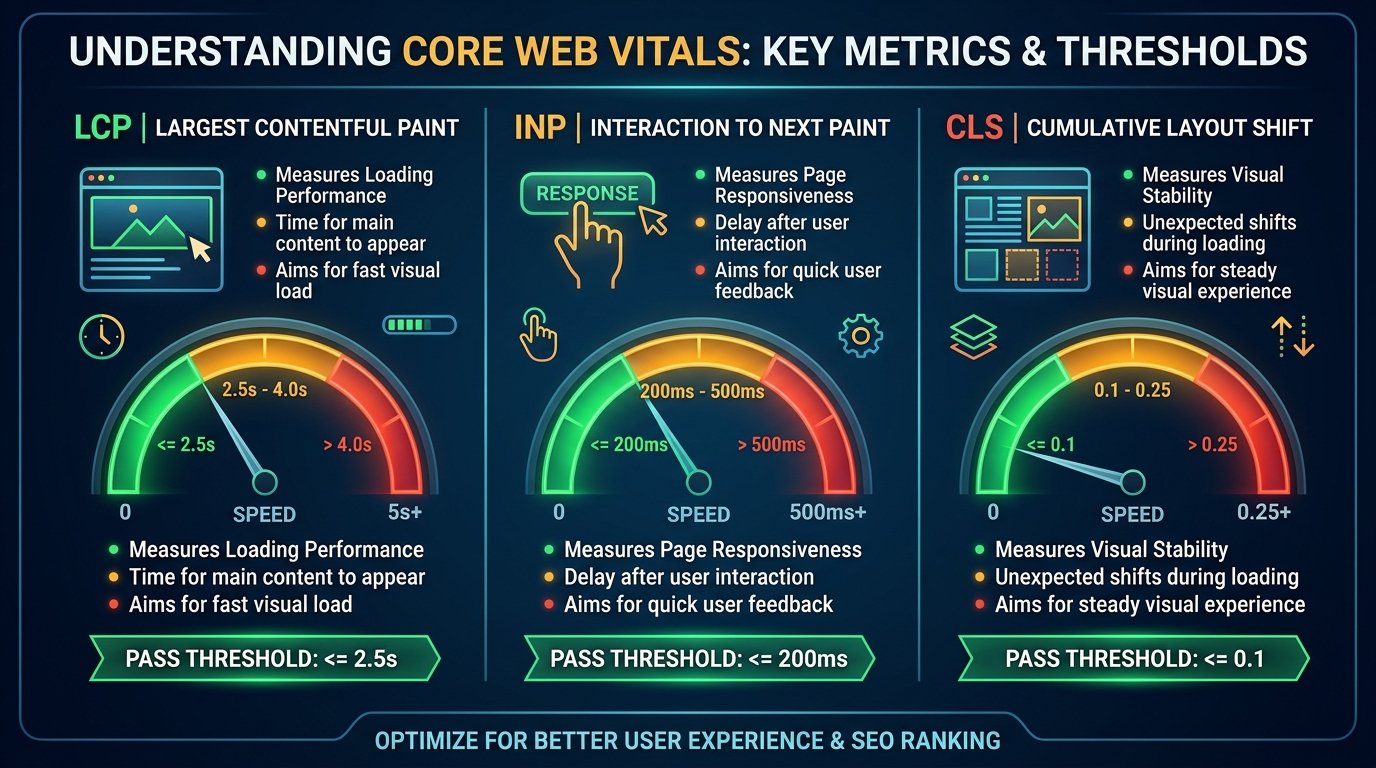
- Core Web Vitals Thresholds: Focus relentlessly on Interaction to Next Paint (INP < 200ms) and Largest Contentful Paint (LCP < 2.5s) on real mobile devices.
- Entity-Driven Schema: JSON-LD structured data is no longer optional. It builds the semantic knowledge graph that fuels both Google Search rankings and AI answer engine citations.
- Internal Link Architecture: A flat, logical site hierarchy with descriptive contextual anchor text passes authority much more effectively than passive breadcrumbs alone.
- Evergreen Hygiene: Avoid redirect chains, soft 404s, and duplicate query strings by enforcing strict canonical rules across your entire CMS.
Whether you run an enterprise platform, an e-commerce store, or are implementing targeted SEO strategies for startups, this checklist provides a battle-tested roadmap used by our technical specialists to audit, diagnose, and supercharge organic crawl performance.
1. Crawlability & Bot Governance Architecture
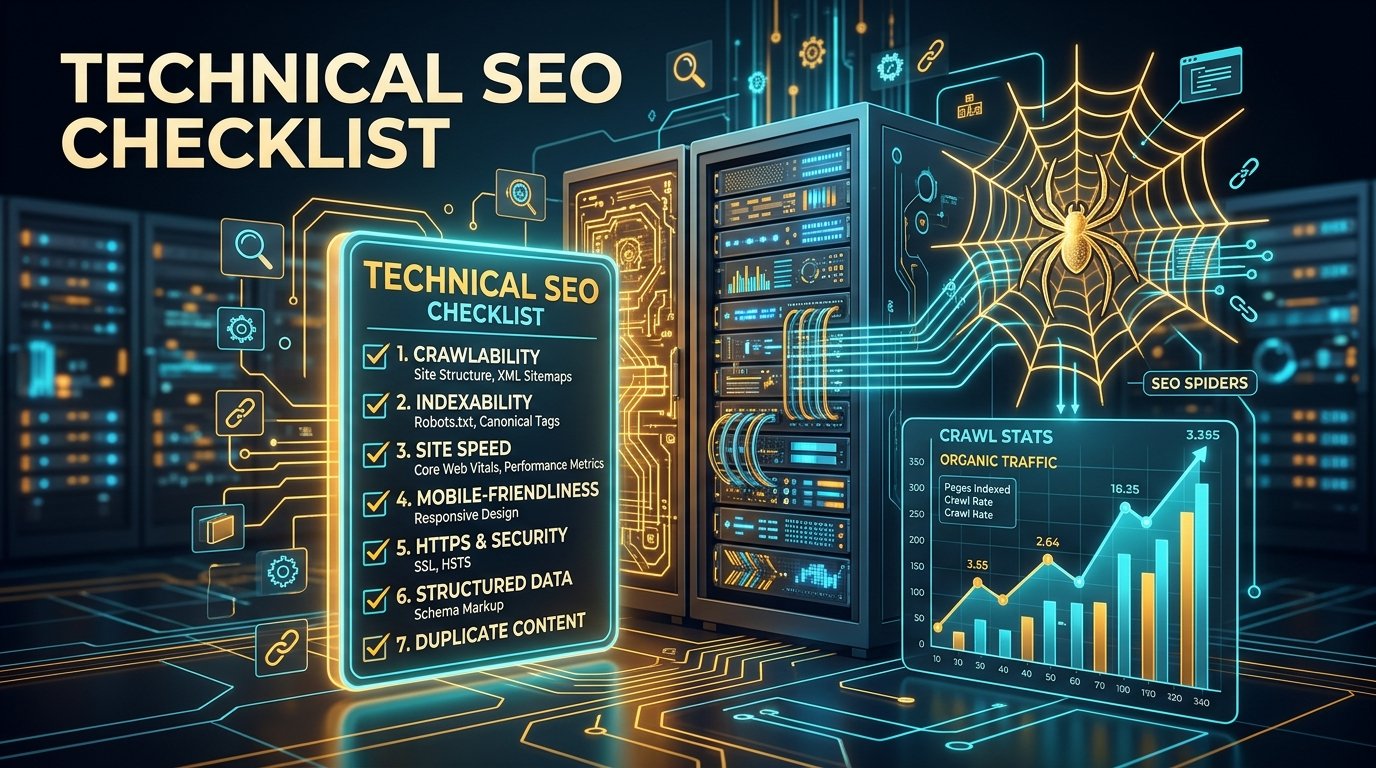
Before Google, Bing, or AI answer engines can rank your pages, they must discover and crawl them without burning excessive resources. Crawl budget is a finite reality for any growing site.
Optimize Your Robots.txt Directives
Your robots.txt file is your first line of defense. A single misplaced slash can de-index an entire website overnight. At SEO Sadhu, we recommend auditing your file every quarter:
- Verify that CSS, JavaScript, and image directories are never blocked. Search crawlers must render the full visual page to evaluate UX accurately.
- Explicitly define crawl permissions for modern search spiders as well as AI crawlers. For example, if you want your content cited when users ask conversational queries, understand how to rank your website on ChatGPT and generative engines by allowing verified bots like
GPTBotandPerplexityBotto access public content. - Ensure your XML sitemap URL is clearly declared at the bottom of the file:
Sitemap: https://seosadhu.com/sitemap_index.xml.
XML Sitemap Precision
Many webmasters treat sitemaps as dumping grounds for every URL generated by their CMS. That is a critical mistake. Your XML sitemap should function as an authoritative whitelist of your absolute best content:
- Include strictly 200 OK indexable canonical URLs.
- Strip out paginated paths, URLs with tracking parameters, password-protected resources, and redirected (3xx) or broken (4xx) pages.
- Break large sitemaps into smaller child sitemaps containing fewer than 10,000 URLs each to speed up discovery.
2. Core Web Vitals & Page Experience Optimization
Speed is not merely a ranking tiebreaker; it directly controls bounce rates and conversion velocity. In modern search algorithms, performance is assessed using real-world user metrics (CrUX data).
| Core Metric | Focus | Good Target | Key Fix |
|---|---|---|---|
| INP (Interaction to Next Paint) | Page Responsiveness | < 200 ms | Break up long JS tasks; defer third-party tags |
| LCP (Largest Contentful Paint) | Perceived Load Speed | < 2.5 seconds | Preload hero image; use Edge CDN caching |
| CLS (Cumulative Layout Shift) | Visual Stability | < 0.1 | Set explicit width/height on images & iframes |
| TTFB (Time to First Byte) | Server Response Time | < 800 ms | Upgrade hosting; implement full-page edge cache |
When working with technology brands and software platforms, we emphasize this heavily. As detailed in our breakdown on why SEO is crucial for SaaS growth, high-value decision-makers abandon sluggish websites within three seconds. Cutting TTFB and mastering INP protects both your search positions and your customer acquisition costs.
3. Canonicalization, Duplicate Content & URL Hygiene
Duplicate content dilutes your site’s PageRank and splits keyword ranking signals across multiple URLs. A rock-solid technical setup eliminates ambiguity:
- Self-Referencing Canonical Tags: Every canonical page must contain an explicit
<link rel="canonical" href="https://seosadhu.com/target-page/">matching the exact protocol, subdomain, and trailing-slash standard. - Eliminate Single-Hop Redirect Chains: Internal links should always point directly to the destination URL (HTTP 200). Never force users or bots to hop through HTTP 301 or 302 redirects internally.
- Parameter Stripping & Faceted Navigation: For dynamic directories or e-commerce filters, configure canonical tags to point back to the parent category, or utilize
noindex, followon deep filtered views to avoid index bloat.
4. Semantic Entity SEO & JSON-LD Structured Data
Search engines no longer parse documents as strings of text; they parse them as connected entities. Structured data provides the semantic schema required to confirm what your business does and who authoritatively backs your content.
Any comprehensive strategy delivered by top professional SEO services in India must include rich JSON-LD markup:
- Organization & LocalBusiness Schema: Declare your official company name, logo, contact points, founding details, and verified social profiles via
sameAsarrays. - Person & Author Schema: Reinforce Google’s E-E-A-T guidelines by marking up authors with their professional credentials and external bios. Understanding the core responsibilities of an SEO manager shows why attributing content to experienced practitioners builds long-term algorithmic trust.
- FAQPage Schema: Embed structured questions and answers to claim valuable accordion real estate directly in Google’s SERPs.
- BreadcrumbList Schema: Clarify site taxonomy so search results display clean navigational paths instead of raw URL strings.
5. Internal Linking Architecture & Topic Clusters
Internal links are the vascular system of your website. They distribute authority (PageRank) from high-equity pages (like your homepage) into deeper sub-pages while showing search engines which pages are topically related.
- Contextual In-Body Links: Place natural links inside the body paragraphs of your articles. Contextual links carry substantially more algorithmic weight than footer or sidebar navigation links.
- Descriptive Anchor Text: Ditch generic phrases like “click here” or “learn more.” Use descriptive, keyword-rich anchor phrases that accurately describe the destination page.
- Hub-and-Spoke Topology: Organize content into topic clusters. For example, if you are studying industry benchmarks, our guide on top SEO experts and influencers to follow links naturally into foundational education like free online SEO training resources.
6. Multimedia Insight: Google Official Crawl & Index Guidance
Understanding how modern search engines render dynamic JavaScript frameworks and handle mobile crawl queues is essential for technical accuracy. Watch Google Search Central’s official breakdown below to see how Googlebot processes rendered DOM structures:
7. Voice Search & Conversational Indexing
With smart assistants, mobile voice search, and AI conversational interfaces surging in popularity, technical structures must support natural conversational queries. As outlined in our practical guide on how to optimize websites for voice search, conversational algorithms prefer:
- Short, definitive answers directly beneath heading questions (aim for 40 to 50 words).
- Natural question phrasing modeled after actual spoken syntax (“How do I fix…”, “What is the difference between…”).
- Fast mobile performance on HTTP/3 network connections.
8. Security, Protocol & Server Infrastructure
Foundational server health safeguards user data and prevents costly downtime during high-volume crawl spikes:
- Site-Wide HTTPS & HSTS: Enforce SSL/TLS across 100% of URLs. Implement HTTP Strict Transport Security (HSTS) headers to prevent protocol downgrade attacks.
- HTTP/3 & Brotli Compression: Leverage HTTP/3 for multiplexed packet delivery and Brotli compression to compress text payloads up to 20% smaller than legacy Gzip.
- Custom 404 Error Handling: Ensure broken URLs return a true HTTP 404 or 410 header (never a soft 404 with a 200 OK status) and offer an intuitive search box to retain lost visitors.
For brands competing in high-density regional markets—such as companies partnering with top SEO specialists in Varanasi or expanding through leading SEO agencies in Bangalore—solid hosting infrastructure ensures your site remains responsive under regional traffic spikes.
9. Comprehensive 10-Point Technical SEO Audit Table
| Audit Checkpoint | Audit Tool | Acceptance Criteria |
|---|---|---|
| Robots.txt Health | Google Search Console | No vital assets blocked; sitemap path declared |
| Sitemap Validation | Screaming Frog | 100% 200 OK canonical pages; no 3xx/4xx/5xx |
| Core Web Vitals | PageSpeed Insights / CrUX | LCP < 2.5s, INP < 200ms, CLS < 0.1 |
| Canonical Consistency | Site Audit Crawlers | Exact match, self-referencing on canonical pages |
| Redirect Chains | Httpstatus.io | Zero multi-hop redirect chains internally |
| Structured Data | Rich Results Test | Valid JSON-LD with zero critical errors |
| Mobile Usability | Chrome DevTools | Responsive viewport; identical content across viewports |
| Security & SSL | Qualys SSL Labs | Grade A+ rating; active HSTS header |
| Internal Link Depth | Crawl Graph Analysis | All key revenue pages within 3 clicks of homepage |
| Status Code Accuracy | Server Logs | True 404s for removed pages; no soft 404 errors |
Frequently Asked Questions About Technical SEO
1. What is technical SEO, and why is it important?
Technical SEO focuses on optimizing a website’s server and code architecture so search engines can crawl, render, index, and interpret its content efficiently. Without sound technical SEO, even exceptional content will struggle to rank because search bots cannot parse it properly.
2. How often should a technical SEO audit be performed?
For high-traffic blogs and business sites, a lightweight monthly audit is recommended to catch broken links and redirect chains. A comprehensive, deep technical audit should be conducted at least once every quarter or immediately before and after any site redesign or CMS migration.
3. What is the difference between technical SEO and on-page SEO?
On-page SEO deals with the user-facing content on the page—such as headlines, keyword placement, text copy, and images. Technical SEO deals with backend and architectural elements like crawlability, server response times, schema markup, Core Web Vitals, and indexing directives.
4. Does site speed directly influence organic search rankings?
Yes. Google incorporates Core Web Vitals (LCP, INP, and CLS) as official ranking signals. Slow load speeds not only harm your algorithmic evaluations but also cause human visitors to bounce before viewing your value proposition.
5. What is Interaction to Next Paint (INP), and how do I fix it?
INP measures page responsiveness by tracking the latency of all user interactions (clicks, taps, and keystrokes) throughout a visitor’s session. To fix poor INP, break up long JavaScript execution blocks, minimize CPU thread work, and eliminate heavy unused third-party tracking scripts.
6. What is the difference between a 301 and a 302 redirect?
A 301 redirect signals a permanent move, transferring approximately 90–99% of link equity to the new destination URL. A 302 redirect is temporary and instructs search engines to keep the original URL indexed without passing full ranking equity.
7. How do canonical tags prevent duplicate content penalties?
Canonical tags (rel="canonical") explicitly tell search engines which URL is the master version when identical or highly similar content exists across multiple URLs. This consolidates ranking signals to a single preferred URL.
8. Why are XML sitemaps necessary if search engines can crawl links?
While search engines crawl via internal links, XML sitemaps provide a direct, machine-readable inventory of your primary URLs. They help search bots discover newly published or updated content faster, especially on large or deeply nested websites.
9. How does structured data (Schema markup) help SEO?
Structured data uses Schema.org vocabulary in JSON-LD format to give search engines explicit semantic meaning about your content. It enables rich snippets (such as star ratings, FAQ drop-downs, and event cards) that improve visibility and organic click-through rates.
10. Can a website rank without technical SEO?
In extremely low-competition niches, a site might rank temporarily with poor technical health. However, as competitors optimize their digital assets, technically impaired sites consistently suffer from de-indexation, slow crawl rates, and declining rankings over time.
Scale Your Search Visibility with SEO Sadhu
Fixing technical bottlenecks creates the fertile ground required for your content marketing and link-building efforts to produce compound returns. Whether you need a full enterprise audit or ongoing site maintenance, our team of seasoned practitioners at SEO Sadhu delivers data-driven solutions tailored to your growth goals.
Ready to eliminate technical blockers and dominate the SERPs? Contact SEO Sadhu today for a professional site audit and customized roadmap.