
A website redesign, CMS replatforming, or domain migration should be an exciting business milestone. Yet, without meticulous technical search oversight, migrations frequently become corporate catastrophes—wiping out 40% to 70% of organic traffic and burning millions in enterprise valuation overnight.
⚡ Key Takeaways: Flawless SEO Migration
- Map Every Single URL: Never rely on wildcard redirect rules that dump all legacy URLs onto the homepage. Every historic URL requires a 1-to-1 equivalent target.
- Isolate Staging Environments: Ensure staging sites are password-protected or restricted by HTTP basic authentication to prevent accidental duplicate indexation.
- Audit Prior to DNS Cutover: Validate internal link hierarchies, schema markup, and metadata using our master technical SEO checklist before pointing domain nameservers.
- Prepare for Algorithmic Volatility: If organic performance dips post-launch, consult our triage framework on why organic traffic drops suddenly to diagnose crawl latency vs redirect failures.
- Involve Technical Search Experts Early: Involve seasoned search consultants during wireframing rather than calling them the day before launch. Review our guide on how to choose the right SEO agency to vet technical partners.
At SEO Sadhu, we have guided scores of enterprise platform switches across custom architectures, Shopify Plus, Webflow, and enterprise WordPress. Following a disciplined four-phase roadmap ensures your hard-earned domain equity transfers seamlessly.
1. The Four Phases of a Successful Website Migration
A flawless website migration is 80% preparation, 10% launch execution, and 10% post-launch forensic auditing.

Follow our four-phase migration framework below to safeguard your organic search revenue:
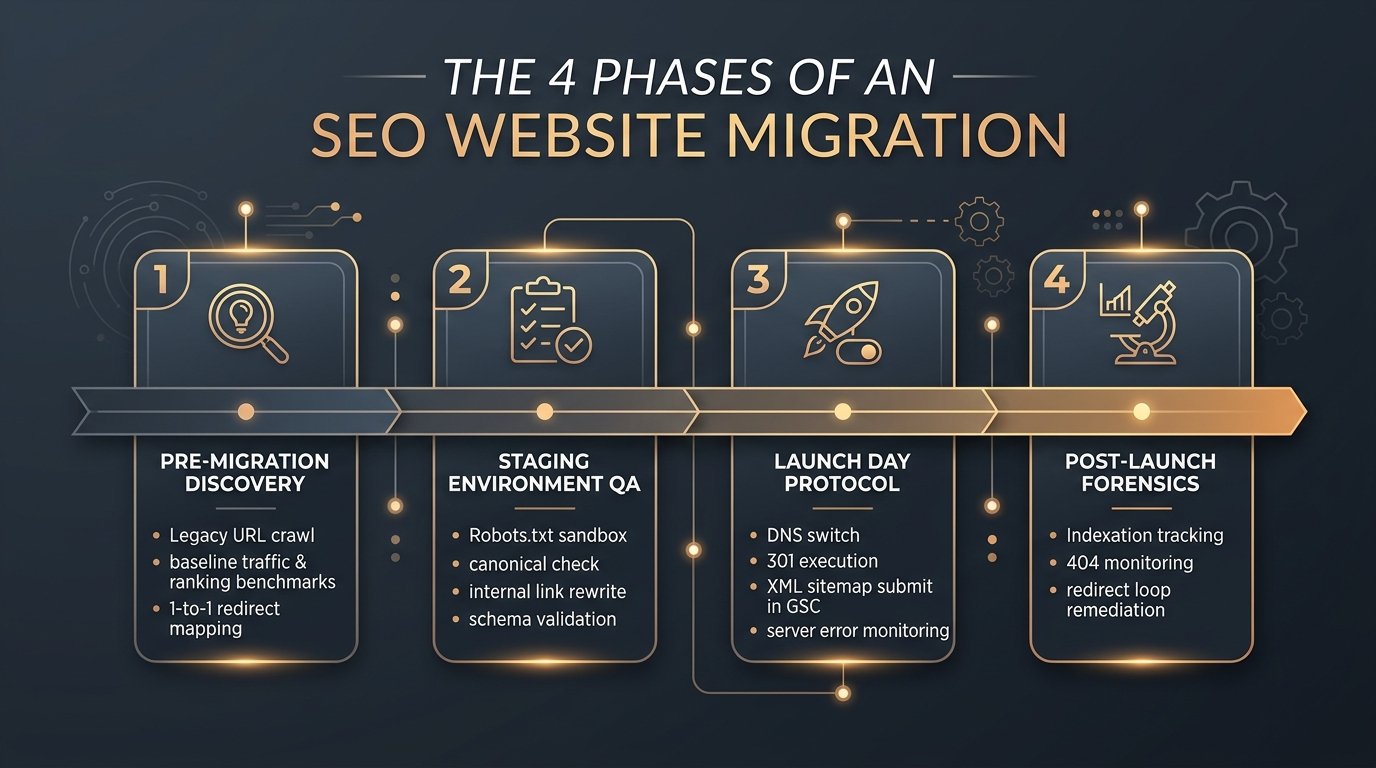
2. Phase 1: Pre-Migration Discovery & Legacy Crawl Benchmarks
You cannot protect what you have not documented. The discovery phase establishes the baseline data against which every post-launch metric will be measured.
Complete these pre-migration actions at least 4 weeks before target launch:
- Full Exhaustive Legacy Crawl: Crawl your existing website using Screaming Frog. Export all HTML URLs, image assets, PDF files, and response codes into a centralized database.
- Synthesize Analytics & GSC Data: Pull the past 12 months of performance data from Google Search Console and Google Analytics 4. Identify your top 20% of URLs that drive 80% of your organic conversions and revenue.
- Backlink Profile Extraction: Export all historical inbound backlinks from Ahrefs and Google Search Console. Every page with high-authority external backlinks must have an exact 301 redirect target to preserve PageRank.
- Draft 1-to-1 Redirect Maps: Map every legacy URL directly to its corresponding new destination URL in a spreadsheet. Avoid redirect chains and never redirect everything to the homepage.
3. Phase 2: Staging Environment Quality Assurance (QA)
Testing must happen in staging, not in production after your site goes live. A single overlooked configuration in testing can sabotage your search engine rankings upon release.
Audit your staging environment against these core technical requirements:
- Crawl Sandbox Protection: Confirm that staging is shielded from public crawlers via HTTP basic authentication (disallowing staging via robots.txt is insufficient because Google can still index bare URLs).
- Self-Referencing Canonical Tags: Verify that new page templates render canonical tags pointing to the production domain rather than staging URLs.
- Internal Link Rewrites: Ensure that all hardcoded internal navigation, header, and footer links point to clean new production paths rather than legacy URLs.
- Structured Data Validation: Validate JSON-LD schema markup (Organization, Article, Product, Breadcrumbs) using the Schema Markup Validator to prevent entity confusion.
As outlined in our guide on the responsibilities of an SEO manager, cross-verifying staging code prevents developers from pushing noindex tags into production.
4. Phase 3: Launch Day Deployment Protocol
Launch day execution should follow a calm, pre-rehearsed script. Schedule cutover during your lowest-traffic window (typically late Tuesday or Wednesday evening).
Execute launch day milestones in this sequence:
- Deploy 301 Redirect Rules: Upload your tested 1-to-1 redirect mapping at the server level (Nginx, Apache, or Cloudflare Edge Workers) for instantaneous execution.
- Remove Staging Blocks: Strip out HTTP basic authentication and update robots.txt to allow Googlebot unrestricted access to CSS, JS, and HTML.
- Verify SSL Certificates: Ensure HTTPS certificates resolve cleanly across both www and non-www variants without mixed-content security warnings.
- Submit Updated XML Sitemaps: Submit clean, error-free XML sitemaps containing only 200 OK indexable URLs directly inside Google Search Console.
- Submit Google Change of Address (if changing domains): If migrating to a new domain name, execute the official Change of Address tool in Google Search Console to expedite algorithmic recognition.
5. Phase 4: Post-Launch Forensics & Daily Monitoring
The first 14 days post-launch determine whether your migration succeeds or falters. Continuous surveillance identifies crawl bottlenecks before they impact organic search revenue.
Monitor these critical health indicators daily:
- Live 404 Error Tracking: Monitor your server access logs and Google Search Console Page Indexing reports to catch broken legacy URLs and immediately deploy 301 patch rules.
- Indexation Velocity: Track how rapidly Googlebot discovers new URLs and drops old URLs from search indexation.
- Core Web Vitals & Page Speed: Confirm that new design frameworks meet mobile speed benchmarks, ensuring page load times remain under 2.5 seconds.
For high-value commercial sectors—such as our enterprise clients evaluating why SEO drives SaaS customer acquisition—having seasoned technical oversight prevents pipeline interruptions.
Whether you require full-scale migration governance across India or localized support from our engineering teams in Bangalore and Varanasi, our structured checklists protect your business valuation.
Frequently Asked Questions About Website Migrations
1. Is some organic traffic loss inevitable during a website migration?
A minor temporary fluctuation of 5% to 10% is normal during the first 2 to 4 weeks while search engines re-crawl and recalculate PageRank across new URL structures. However, severe drops exceeding 25% indicate technical failures in redirect mapping or indexing.
2. How far in advance should we start planning an SEO migration?
Ideally, technical SEO architects should be involved 8 to 12 weeks prior to launch. Early involvement ensures that wireframes, site taxonomy, and URL naming conventions are designed correctly before developers begin building templates.
3. Why shouldn’t we redirect all old URLs to the homepage?
Redirecting thousands of disparate legacy pages to your homepage triggers “Soft 404” errors in Google. Google treats generic homepage redirects as broken pages, completely discarding historical backlink equity and keyword rankings.
4. How long should 301 redirects remain active after a migration?
301 redirects should remain active permanently, or for a minimum of 12 to 24 months. Search engines and human visitors continue referencing legacy bookmarks and external links for years.
5. What is the difference between a 301 and a 302 redirect during migration?
A 301 redirect signals a permanent move and transfers roughly 95% to 99% of PageRank equity to the new URL. A 302 redirect signals a temporary change, causing search engines to retain the old URL in their index and withhold link equity.
6. Can we change our domain name and CMS at the same time?
While possible, executing a domain change and a CMS redesign simultaneously introduces compounding variables that make diagnosing post-launch issues difficult. If feasible, execute the CMS redesign first, stabilize rankings, and migrate domains 90 days later.
7. How much does an enterprise SEO website migration service cost?
Professional migration oversight typically ranges from ₹75,000 to ₹3,50,000 ($1,000 to $4,500 USD) depending on catalog size, as broken down in our comprehensive SEO pricing guide.
8. What tools are essential for auditing a website migration?
Enterprise migration teams rely on Screaming Frog SEO Spider, Sitebulb, Google Search Console, Ahrefs, and Google BigQuery for log file analysis.
9. How do we ensure our in-house developers follow SEO migration protocols?
Review the strategic trade-offs between in-house teams vs agency retainers. Providing developers with clear Jira sprint tickets and automated testing rules ensures technical compliance.
10. What happens if our organic traffic does not recover after 6 weeks?
If rankings remain suppressed after 6 weeks, conduct a forensic log analysis to identify redirect loops, orphaned pages, or server rendering blocks that are preventing Googlebot from completing indexation.
Execute Your Website Migration Risk-Free with SEO Sadhu
Migrating your website should accelerate your digital growth, not destroy your search engine visibility. Don’t leave years of organic equity to chance.
At SEO Sadhu, our technical SEO architects provide end-to-end migration governance, safeguarding your rankings and revenue throughout every stage of deployment. Planning a website redesign or replatforming? Contact our migration team today to schedule your pre-launch discovery audit.