For Chief Marketing Officers and Revenue Operations leaders, the greatest operational disconnect in organic marketing is the divide between search analytics and CRM pipeline. Marketing agencies celebrate traffic spikes and keyword rankings, while sales leaders complain about unqualified form fills and CFOs demand to know exact closed-won revenue figures. By connecting SEO directly to HubSpot CRM, enterprise brands transform search from an opaque cost center into a mathematically verified revenue engine.
- The First-Touch Attribution Blindspot: Traditional Google Analytics session metrics fail to track long enterprise sales cycles (3 to 9 months). Without CRM synchronization, organic search rarely receives credit for closing six-figure deals initiated via early blog discovery.
- Hidden Field Parameter Capture: Passing first-page-seen, organic referrer, and landing page URLs into hidden HubSpot contact properties guarantees full deal lineage across the entire sales lifecycle.
- Closed-Loop Reporting: Synchronizing Google Search Console query clusters with HubSpot Deal Stages allows marketing teams to double down on keywords that generate high-velocity sales opportunities rather than hollow vanity traffic.
Attribution Models: Which Framework Proves SEO Value?
Selecting the right attribution model inside HubSpot dictates how your executive board perceives the financial return on your organic search investment:
| Attribution Model | How Revenue is Assigned | Impact on SEO Perception | Best Use Case |
|---|---|---|---|
| First-Touch Attribution | 100% of deal value is attributed to the initial content asset that introduced the prospect. | Massively favors top-of-funnel informational SEO clusters. | Proving initial brand discovery value for long-cycle enterprise B2B sales. |
| Last-Touch Attribution | 100% of deal value goes to the final touchpoint before demo booking or checkout. | Severely undervalues organic search in favor of retargeting ads or direct visits. | Transactional e-commerce with same-day purchase cycles. |
| W-Shaped Attribution | 30% to First Touch, 30% to Lead Creation, 30% to Deal Creation, 10% across middle touches. | The Gold Standard: Equitably credits discovery SEO and bottom-of-funnel conversion pages. | Complex B2B SaaS, healthcare networks, and industrial manufacturing deals. |
The 4-Step Technical Pipeline: Connecting SEO to HubSpot
1. Deploy Persistent Cookie & Hidden Form Field Tracking
Standard HubSpot tracking scripts capture basic referrers, but visitors often browse multiple pages before submitting a form. To capture the true originating keyword cluster:
- Create custom HubSpot contact properties:
First Organic Landing Page,Original Organic Referrer, andFirst Conversion Asset. - Write a lightweight JavaScript snippet that stores the initial landing page URL in a first-party cookie or
localStoragesession. - Embed hidden fields inside all HubSpot demo forms, dynamic lead popups, and gated whitepaper forms to populate these properties automatically upon submission.
2. Align Organic Content Clusters with HubSpot Lifecycle Stages
Stop treating all organic leads as equal. Map your website content silos directly to HubSpot lifecycle stages:
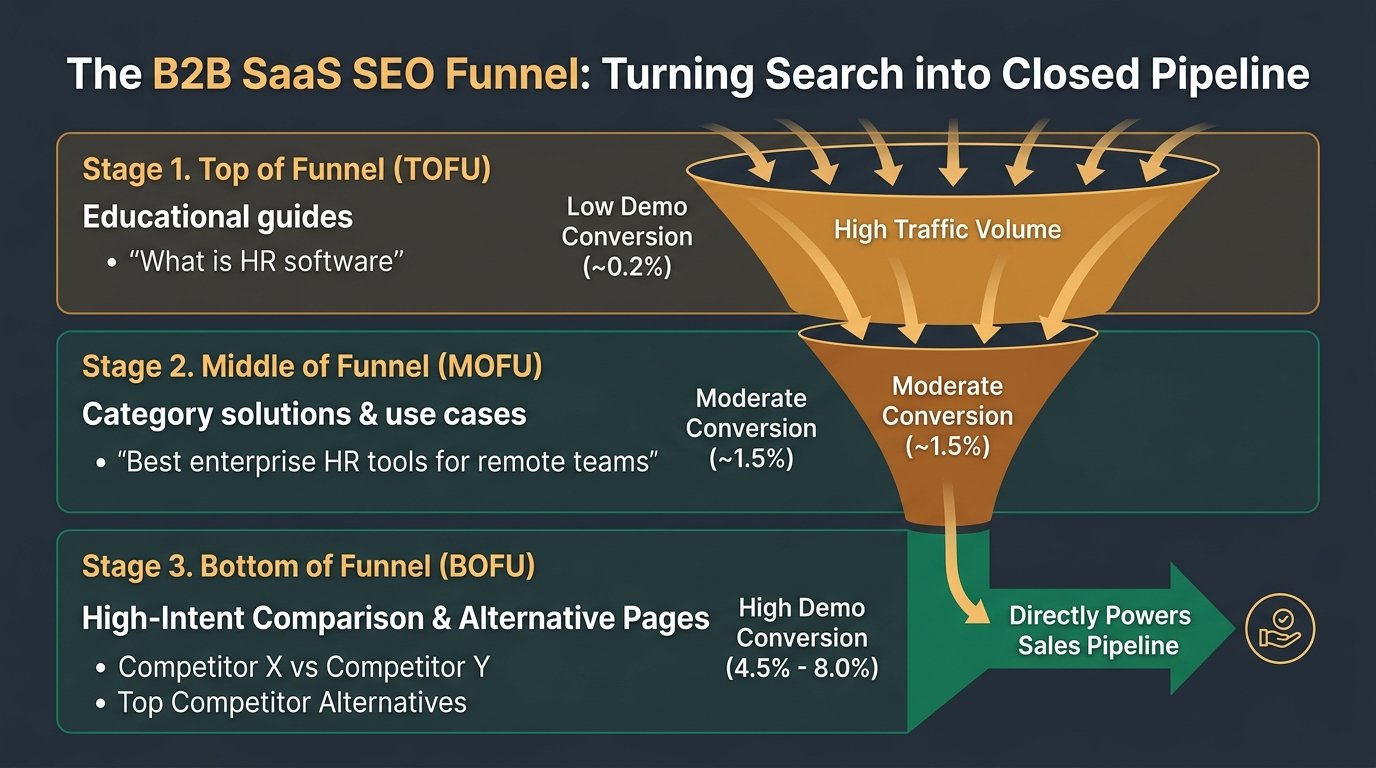
- Subscriber / Lead: Captures top-of-funnel educational searchers (e.g., industry benchmark reports, glossary definitions).
- Marketing Qualified Lead (MQL): Captures middle-of-funnel comparative searchers (e.g., template downloads, diagnostic audit checklists).
- Sales Qualified Lead (SQL): Captures bottom-of-funnel transactional searchers (e.g., competitor alternative pages, pricing calculators, demo requests).
3. Build the Closed-Loop Pipeline Revenue Dashboard
Inside HubSpot’s Custom Report Builder, construct an executive dashboard filtered exclusively for deals where Original Source Data 1 = ORGANIC_SEARCH:
- Organic Pipeline Generated: Total currency value of active open opportunities sourced from organic search.
- Organic Closed-Won Revenue: Total realized cash revenue credited to search touchpoints.
- Average Deal Size by Organic Landing Page: Pinpointing which specific content assets generate the largest contract sizes.
4. Sync Revenue Feedback to SEO Content Sprints
Once revenue attribution is live, hold monthly RevOps alignment meetings. If a specific keyword cluster generates high traffic but zero closed revenue, eliminate it from future editorial sprints. If an unheralded technical guide on a complex integration generates three $80,000 enterprise contracts, immediately commission related cluster content.
Prove the Exact Revenue Value of Your SEO Program
At SEO Sadhu, we don’t report on hollow traffic metrics. We integrate search intelligence directly into your HubSpot or Salesforce CRM, proving exact pipeline generation, lower customer acquisition costs, and verified closed-won ROI.
Frequently Asked Questions (FAQ)
Why does HubSpot classify organic traffic as “Direct Traffic” sometimes?
This happens when a user discovers your site via organic search on mobile, copies the link to their desktop later, or visits your site via an HTTPS-to-HTTP redirect or privacy-focused browser that strips the HTTP referrer header. Storing first-touch referrer data in local storage helps mitigate this misclassification.
Can we see exact keyword queries inside HubSpot?
Because Google encrypts search query data (marking over 98% of queries as “not provided” in referrer URLs), HubSpot cannot capture exact keyword strings on a contact level. However, by tracking the exact Landing Page URL and integrating Search Console data, you can correlate deal revenue with specific keyword clusters with high precision.
Which HubSpot subscription tier is required for multi-touch attribution?
HubSpot Marketing Hub Enterprise or Operations Hub Enterprise is required to utilize pre-built W-shaped, U-shaped, and Full-Path multi-touch attribution models. However, basic First-Touch and Last-Touch source reporting is available in Marketing Hub Professional.