In competitive enterprise markets, organic market share is a zero-sum game. When your company wins the number one position on a high-value commercial search term, an incumbent competitor loses it. For agile challengers looking to displace legacy market leaders, deploying an aggressive, legally compliant Competitor Organic Attack Plan is the fastest way to capture qualified inbound pipeline without spending millions on paid media.
- The Incumbent Blindspot: Large legacy competitors are slow, bloated, and trapped by technical debt. Their content is often five years old, unoptimized for modern search intents, and failing Core Web Vitals.
- Content Gap Conquesting: Reverse-engineering the top 10% of pages that drive 80% of your rival’s organic revenue allows you to deploy superior, data-backed counter-assets that displace them on prime SERPs.
- Broken Link & Equity Reclaiming: Auditing competitor 404 error URLs and expired product lines enables your outreach team to approach linking publishers and absorb their lost domain authority.
The 4 Strategic Competitor Attack Vectors
| Attack Vector | Vulnerability Exploited | Tactical Execution |
|---|---|---|
| 1. Keyword & Content Gap Conquesting | Incumbent ranks with outdated, shallow 800-word guides from 2021. | Publish comprehensive, data-rich pillar guides featuring original research and downloadable SOPs. |
| 2. Broken Backlink Reclamation | Competitor sunsets a product or restructures URLs without 301 redirects, resulting in dead 404 links. | Contact referring journalists and universities, notifying them of the dead link and providing your live replacement. |
| 3. Brand Sentiment & Churn Interception | Rival introduces price increases, changes licensing terms, or suffers service outages. | Deploy targeted “[Competitor] Migration & Pricing Rescue” landing pages with instant switching discounts. |
| 4. Digital PR Share of Voice Displacement | Incumbent relies on stale PR relationships without issuing new proprietary data studies. | Release annual industry benchmark reports that journalists citation-source over aging competitor figures. |
Step-by-Step Execution: Reverse-Engineering Competitor Authority
Step 1: Isolate the “Money Pages” of Your Rivals
Do not audit every page on your competitor’s domain. Filter their site architecture to isolate the top 5% to 10% of URLs that generate their primary organic revenue. Identify their highest-value commercial landing pages, core product silos, and high-converting tool hubs.
Step 2: Deploy the 10x Content Superiority Framework
To displace an entrenched page that has accumulated years of domain authority, your replacement asset cannot simply be 10% better; it must be demonstrably superior:
- Original Data: Include proprietary benchmarks or survey data that the competitor does not have.
- Interactive Utilities: Embed instant calculation widgets, downloadable templates, or diagnostic scorecards.
- Technical Precision: Outperform them on Core Web Vitals (sub-1.5s LCP) and flawless mobile responsiveness.
Step 3: Exploit Competitor Pricing Shocks
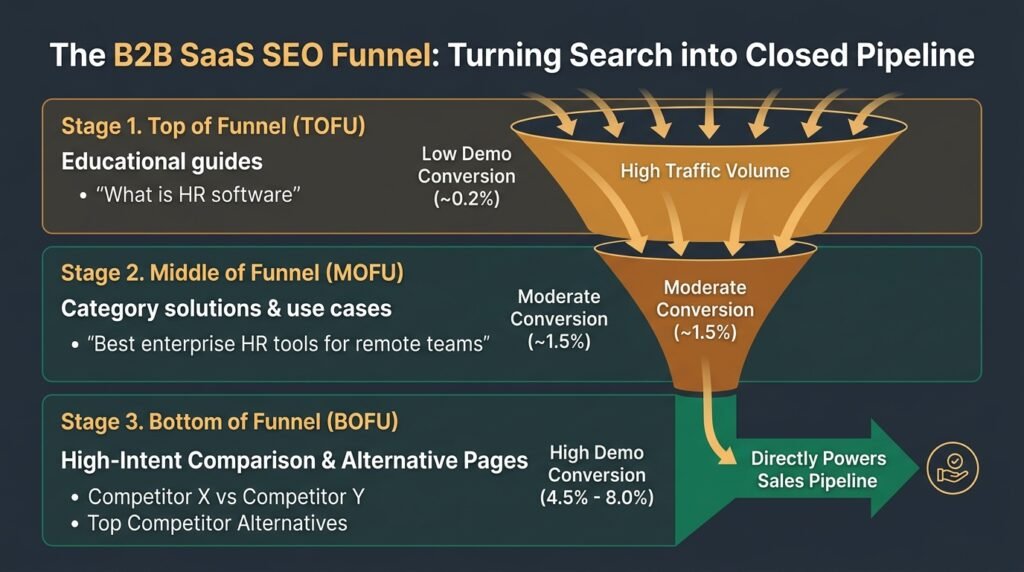
Whenever a market leader announces an aggressive price hike or restricts features on entry-level tiers, commercial search volume for “[Competitor] alternatives” spikes by 300% to 500% within 48 hours. By monitoring industry forums and having pre-optimized comparison assets ready to deploy, you capture these disgruntled buyers before your rival can respond.
Ready to Outrank and Outsell Your Competitors?
At SEO Sadhu, we engineer competitive organic attack plans that systematically capture market share from industry incumbents. We identify their technical vulnerabilities, exploit their content gaps, and turn their lost rankings into your revenue.
Frequently Asked Questions (FAQ)
Is competitor keyword targeting legal in organic search?
Yes. Optimizing for terms that your competitors rank for, or creating factual comparison pages comparing your platform to theirs, is completely legal and standard practice in commercial search marketing, provided all published claims are accurate, truthful, and substantiated.
How long does it take to outrank an established competitor?
For long-tail and middle-of-funnel comparative terms, well-engineered assets can outrank competitors within 60 to 90 days. For high-volume, core generic head terms, displacing a high-authority incumbent typically requires 6 to 9 months of sustained technical optimization and digital PR link acquisition.
How do we protect our own website against competitor attack plans?
Maintain an active content refresh cycle, monitor your backlink health for 404 broken redirect opportunities, keep your Core Web Vitals in the green “Good” threshold, and ensure your comparison pages represent your own product narrative objectively before competitors define it for you.