Google AI Overviews have fundamentally rewritten the rules of organic search. When Google displays a generative snapshot at the very top of search engine results, traditional organic listings are pushed down by hundreds of pixels. If your content is not cited within that AI summary card, you lose high-intent organic clicks before users even begin scrolling.
⚡ Key Takeaways: Winning Google AI Overviews
- Top 10 Correlation: Over 84% of links cited in Google AI Overviews come from domains that already rank in the top 10 organic results for that query.
- Direct Answer Syntax: Formulate 40-to-60 word definitive answers immediately beneath your H2 and H3 question subheadings.
- Structured Entity Markup: Use schema.org JSON-LD to map organizations, authors, and conceptual relationships directly to Google’s Knowledge Graph.
- Information Gain: Pure regurgitated content gets ignored. AI models favor first-party data, proprietary client benchmarks, and original case studies.
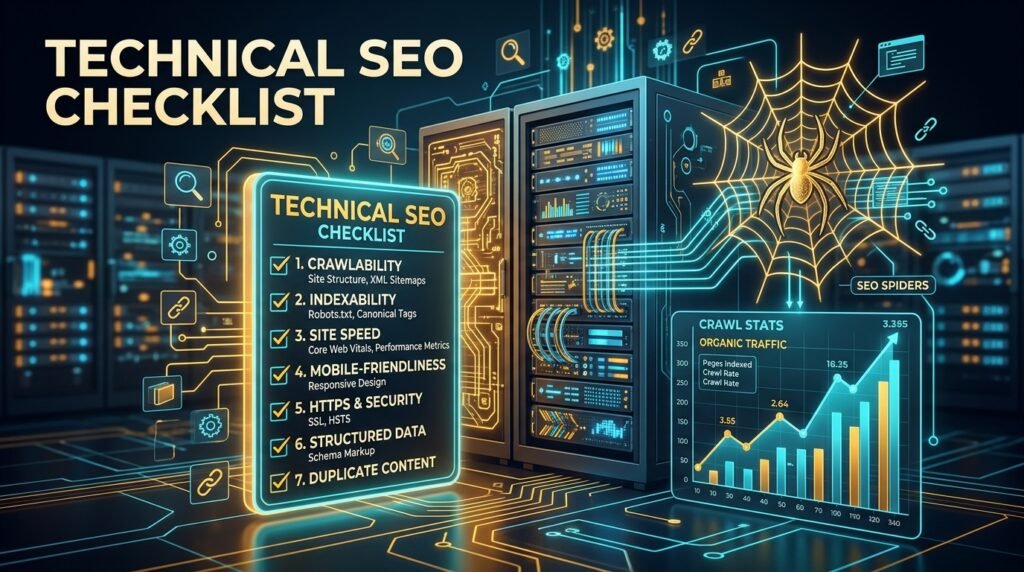
- Zero Crawler Blockers: Ensure your site architecture is technically sound by verifying our complete technical SEO checklist so Googlebot can crawl and index without latency.
At SEO Sadhu, we have spent months reverse-engineering which pages get cited in Google AI Overviews versus which ones get ignored. Winning this placement does not require tricking an algorithm. It requires structuring your content so an LLM can easily extract, trust, and quote your insights.
1. How Google AI Overviews Actually Select Sources
Google AI Overviews do not simply generate text out of thin air. They utilize a specialized process known as Retrieval-Augmented Generation (RAG) paired with Gemini models and Google’s core ranking systems.

When a user types a query, Google executes a multi-step retrieval pipeline:
- Query Intent Classification: Google determines whether a generative summary adds value. Informational, how-to, and multi-variable comparison queries trigger AI Overviews most frequently.
- Candidate Retrieval: Google pulls a pool of top-ranking organic documents from its index. If your site does not have strong baseline organic rankings, your odds of appearing in the AI Overview drop dramatically.
- Reranking for Factual Consensus: The retrieval engine cross-references candidate pages against established knowledge base entities to confirm factual agreement.
- Synthesis & Inline Citation: The Gemini model summarizes the findings into clean paragraphs or bulleted steps, inserting link cards to the authoritative pages that contributed each fact.
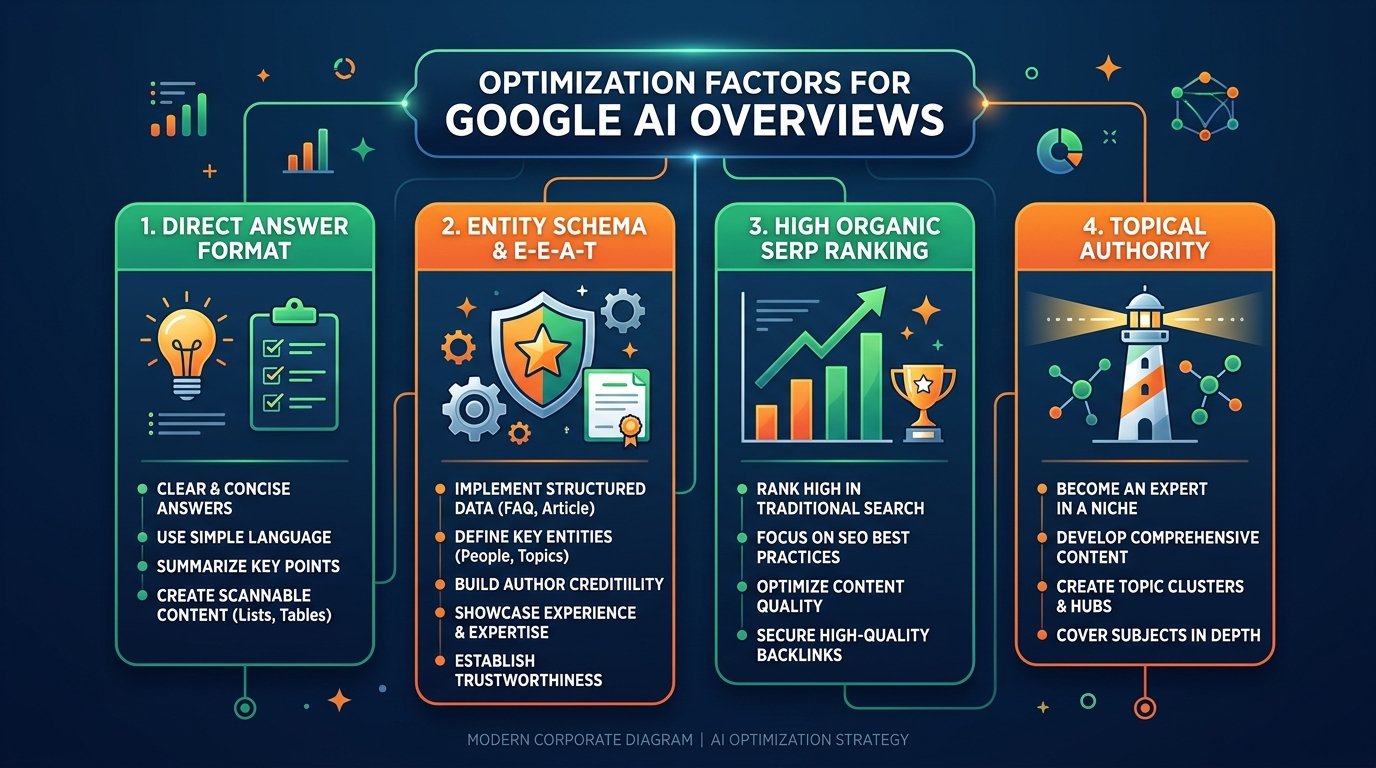
2. The 4 Pillars of Generative Engine Optimization (GEO)
Optimizing for AI snapshots requires a dual-track strategy: ranking in traditional search while formatting for algorithmic extraction.
Pillar 1: Direct Answer Architecture
AI models search for extractable nuggets of information. Write your content using an inverted pyramid structure:
- Place a crisp 45-to-55 word direct answer immediately beneath every H2 question heading.
- Use clear, simple declarative sentences without unnecessary fluff or throat-clearing.
- Follow the direct answer with ordered lists, bullet points, or structured breakdown tables.
Pillar 2: Entity Mapping & E-E-A-T Schema
Google needs mathematical confidence that your authors and business are trustworthy authorities. As our specialists emphasize when delivering enterprise SEO services in India, entity validation is the backbone of modern AI trust:
- Implement comprehensive
Organization,Person, andArticleschema in JSON-LD. - Connect author profiles to verified industry entities using
sameAslinks pointing to LinkedIn, Wikipedia, and recognized publications. - Review the core responsibilities of an SEO manager to align your editorial team with strict accuracy guidelines.
Pillar 3: High Baseline Organic Rankings
AI Overviews do not replace traditional search engine ranking factors; they sit on top of them. While exploring how ChatGPT sources and quotes websites, we found that AI engines disproportionately favor pages that Google already ranks on page one.
Pillar 4: Deep Topical Authority & Hub Structure
Publishing one-off articles on random keywords will not cut it. You must demonstrate exhaustive topic coverage by building interlinked content hubs. Whether crafting growth SEO strategies for startups or scaling enterprise blogs, grouping content into structured topic clusters signals clear domain specialization.
3. Content Formatting Techniques That Win AI Citations
Formatting directly determines whether a language model can extract your data accurately. Follow these practical layout rules across every article:
| Content Format | Best Practice for AI Overviews | Common Mistake to Avoid |
|---|---|---|
| Definitions & Explanations | Bold target terms, provide immediate 45-word answers | Starting with vague clichés or storytelling delays |
| Step-by-Step Guides | Use numbered HTML lists (<ol>) with bold action verbs |
Hiding critical steps inside dense wall-of-text paragraphs |
| Comparative Data | HTML tables with explicit <th> column headers |
Embedding comparison tables inside flat PNG images |
| Statistics & Proof | Cite verified percentages and external primary studies | Quoting generic unsourced claims without attribution |
For brands operating in competitive digital hubs—such as technology companies consulting with top SEO specialists in Varanasi or leading SEO agencies in Bangalore—clean HTML formatting makes your content effortless for crawlers to ingest.
4. Official Technical Perspectives on Generative Search
Staying grounded in official Google Search Central documentation prevents you from wasting budget on speculative hacks. Google’s search engineering team has made it clear that AI Overviews follow core information retrieval principles rather than secret shortcuts.
“Google’s systems automatically determine whether a search query warrants an AI summary based on query ambiguity, intent, and our ability to synthesize authoritative consensus across multiple index documents.”
— Google Search Central Engineering Principles
Notice how Google engineers continually emphasize original reporting and accessibility. Following industry thought leaders from our curated list of top SEO influencers and search authorities will help you track subtle algorithm shifts before they disrupt your organic visibility.
5. Voice Search and Conversational AI Alignment
AI Overviews share substantial structural DNA with voice search algorithms. When a user asks Google a conversational prompt, the underlying processing mimics spoken language comprehension.
As detailed in our practical playbook on how to optimize websites for voice search, structuring headers around natural interrogative questions (Who, What, Where, When, How) gives search algorithms ready-made segments to cite.
Furthermore, in specialized commercial verticals—such as analyzing why SEO drives SaaS customer acquisition—users frequently ask long-tail comparison queries like “How does Tool X compare to Tool Y for enterprise teams?” Answering these exact questions directly captures AI Overview real estate before your competitors even realize the search volume exists.
6. Step-by-Step AI Overview Optimization Checklist
- Audit Trigger Queries: Identify which of your target commercial and informational queries currently trigger an AI Overview in Google.
- Analyze Existing Citations: Check which 3 to 5 domains Google cites in that snapshot. Note their word count, schema markup, and heading structure.
- Insert Inverted Pyramid Answers: Craft a 50-word direct summary directly under your main H2 heading.
- Add Supporting Data Tables: Present key metrics, pricing tiers, or comparison specifications in clean HTML tables.
- Implement Valid FAQ Schema: Add at least 5 to 10 structured FAQs matching People Also Ask questions.
- Audit Technical Core Web Vitals: Verify that mobile pages load in under 2.5 seconds using our actionable technical SEO checklist.
- Build Topical Hub Links: Interlink your article to related guides across your domain to reinforce topical authority.
Frequently Asked Questions About Google AI Overviews
1. What are Google AI Overviews?
Google AI Overviews are generative artificial intelligence snapshots displayed at the top of Google search results. Powered by custom Gemini models, they summarize information from multiple web pages and provide clickable citation cards to primary sources.
2. Can you optimize specifically for Google AI Overviews?
Yes. Generative Engine Optimization (GEO) involves structuring content with direct 45-to-50 word answers, implementing entity-rich JSON-LD schema, ranking on page one organically, and organizing data into tables and numbered lists that LLMs can extract easily.
3. How do Google AI Overviews affect website traffic?
For simple definition queries, AI Overviews can reduce click-through rates by providing immediate answers on the SERP. However, for complex research and commercial comparison queries, winning an AI Overview citation card drives qualified, high-intent referral traffic.
4. Do you need to rank in the top 10 to appear in an AI Overview?
In the vast majority of cases, yes. Independent studies indicate that over 80% of citation links inside Google AI Overviews originate from domains already ranking in the top 10 organic positions for that target query.
5. Can I block my content from appearing in Google AI Overviews?
You can use standard robots meta tags like nosnippet, data-nosnippet, or max-snippet to limit how much text Google extracts. However, blocking snippets may also prevent your site from earning regular featured snippets and rich search enhancements.
6. What is the difference between a Featured Snippet and an AI Overview?
A Featured Snippet pulls a single excerpt from one top-ranking website. An AI Overview synthesizes information from multiple websites simultaneously, generating an original multi-paragraph summary with multiple inline citation links.
7. Does structured data (Schema) help with AI Overview visibility?
Yes. While schema markup does not guarantee inclusion, JSON-LD structured data helps Google’s Knowledge Graph verify the factual accuracy, author credentials, and organizational entities behind your content, increasing algorithmic confidence.
8. Which types of queries trigger AI Overviews most often?
Informational queries, multi-step troubleshooting guides, comparison queries (“best X vs Y”), and queries containing multiple conditional variables trigger AI Overviews far more frequently than local or navigational searches.
9. How can I track if my website is appearing in Google AI Overviews?
Currently, Google Search Console combines AI Overview impressions with standard web search performance. You can use specialized third-party SERP tracking platforms like Semrush, Ahrefs, or BrightEdge to monitor AI Overview appearance across your target keyword sets.
10. What is Information Gain, and why does Google care about it?
Information Gain measures whether your page adds new, unique value beyond what already exists on top-ranking sites. Google’s algorithms prioritize original data, first-party testing, and unique perspectives to prevent AI snapshots from summarizing repetitive generic content.
Dominate the Future of Search with SEO Sadhu
Generative search is not the end of organic visibility; it is simply a new arena for quality-driven brands to outshine generic competitors. At SEO Sadhu, we help businesses adapt their digital architecture, capture AI Overviews, and secure dominant search positions.
Ready to turn generative search into a reliable growth channel? Reach out to the search specialists at SEO Sadhu today to schedule your comprehensive content audit.