
Many business owners invest heavily in sleek website designs and weekly blog posts, only to watch their organic traffic plateau. When digital visibility stalls, the problem is rarely a lack of effort; it is almost always invisible architectural bugs, indexing bloat, and content cannibalization quietly bleeding your organic revenue.
⚡ Key Takeaways: The Value of a Professional SEO Audit
- Beyond Automated Scanners: Free online scanning tools produce superficial reports filled with generic warnings. A forensic audit investigates server log files, rendering pipelines, and revenue attribution.
- Uncover Hidden Technical Leaks: Identify silent indexing blockers, canonical misconfigurations, and crawl traps using our master technical SEO checklist.
- Prevent Catastrophic Redesign Disasters: Commissioning an audit prior to a CMS replatforming prevents the severe traffic losses detailed in our website migration SEO checklist.
- Evaluate Strategic Trade-Offs: Determine whether executing audit recommendations requires an internal team or outside partner using our in-house vs agency comparison.
- Understand Fair Market Costs: Explore realistic audit pricing tiers in our comprehensive SEO pricing guide before commissioning work.
At SEO Sadhu, our forensic audits serve as the diagnostic foundation for every enterprise campaign we execute. Identifying and repairing hidden technical bottlenecks transforms stagnant domains into high-performing organic revenue engines.
1. The Four Layers of a Forensic SEO Audit
A true professional audit evaluates your digital ecosystem holistically rather than generating a checklist of meta tag lengths.

A comprehensive forensic audit investigates four interconnected operational layers:
2. Layer 1: Crawl Accessibility & Indexation Hygiene
If search engine bots cannot efficiently discover, render, and index your high-margin pages, even world-class content will never rank.
The technical crawl audit examines:
- Server Log File Behavior: Analyzing raw web server access logs to see which pages Googlebot crawls frequently and which URLs waste crawl budget.
- JavaScript Hydration & Two-Wave Indexing: Confirming that search engines render dynamic JavaScript frameworks (React, Angular, Next.js) without losing key heading or text elements.
- Orphaned URL Detection: Uncovering pages that exist in your XML sitemap but have zero internal links pointing to them from the rest of your site.
3. Layer 2: On-Page Semantic Architecture & Cannibalization
As websites grow, multiple writers often publish overlapping articles that target identical search intent. This keyword cannibalization splits your domain’s PageRank, preventing any single page from reaching the top 3 positions.
A forensic audit maps your entire content inventory to distinct search intents. Combining cannibalizing pages into comprehensive pillar guides—and structuring content to capture citations in Google AI Overviews—reclaims lost ranking power.
4. Layer 3: Backlink Health & Algorithmic Penalty Risk
Inbound links remain a potent ranking signal, but toxic backlinks from low-quality directories and spam networks create serious liability.
If your company previously worked with a low-cost vendor displaying the warning signs covered in our guide to major agency red flags, an audit uncovers paid link networks and generates a clean disavow file before Google’s SpamBrain algorithm triggers an algorithmic drop.
Furthermore, if your site has already suffered an unexplained traffic dip, an audit isolates the exact cause using our diagnostic triage on why organic traffic drops suddenly.
5. Layer 4: Competitive Gap & Commercial Pipeline Analysis
A quality audit does not just list bugs; it reveals missed market opportunities. By analyzing the top 5 ranking competitors across your commercial keyword landscape, an audit uncovers high-intent queries your brand has completely ignored.
In competitive commercial verticals—such as our enterprise software clients utilizing our B2B SaaS SEO framework—closing competitor content gaps directly accelerates sales demo volume and pipeline velocity.
Reviewing the defined responsibilities of an SEO manager emphasizes why structured audit roadmaps give your in-house developers exact Jira sprint deliverables.
Whether you require full-scale enterprise auditing across India or specialized local review from our teams in Bangalore and Varanasi, establishing an objective diagnostic baseline protects your capital.
Frequently Asked Questions About Professional SEO Audits
1. What is the difference between a free automated SEO audit and a professional audit?
Free automated scanning tools run surface-level scripts that check basic character counts and missing alt tags. A professional forensic audit analyzes server access logs, rendering pipelines, backlink toxicity, and multi-touch revenue attribution.
2. How often should a business perform an in-depth SEO audit?
Enterprise organizations should conduct a comprehensive forensic audit annually, supplemented by quarterly technical health checks and pre-migration audits prior to any major website redesign or CMS release.
3. How long does a comprehensive professional SEO audit take to complete?
A thorough technical and content audit typically requires 2 to 4 weeks depending on catalog size, architecture complexity, and historical URL volume.
4. What deliverables should we expect from an SEO audit?
You should receive an executive summary, an itemized technical findings document, developer-ready Jira tickets with priority ratings (P0 Critical, P1 High, P2 Moderate), and a 90-day implementation roadmap.
5. Can an audit help us recover from a Google Core Update drop?
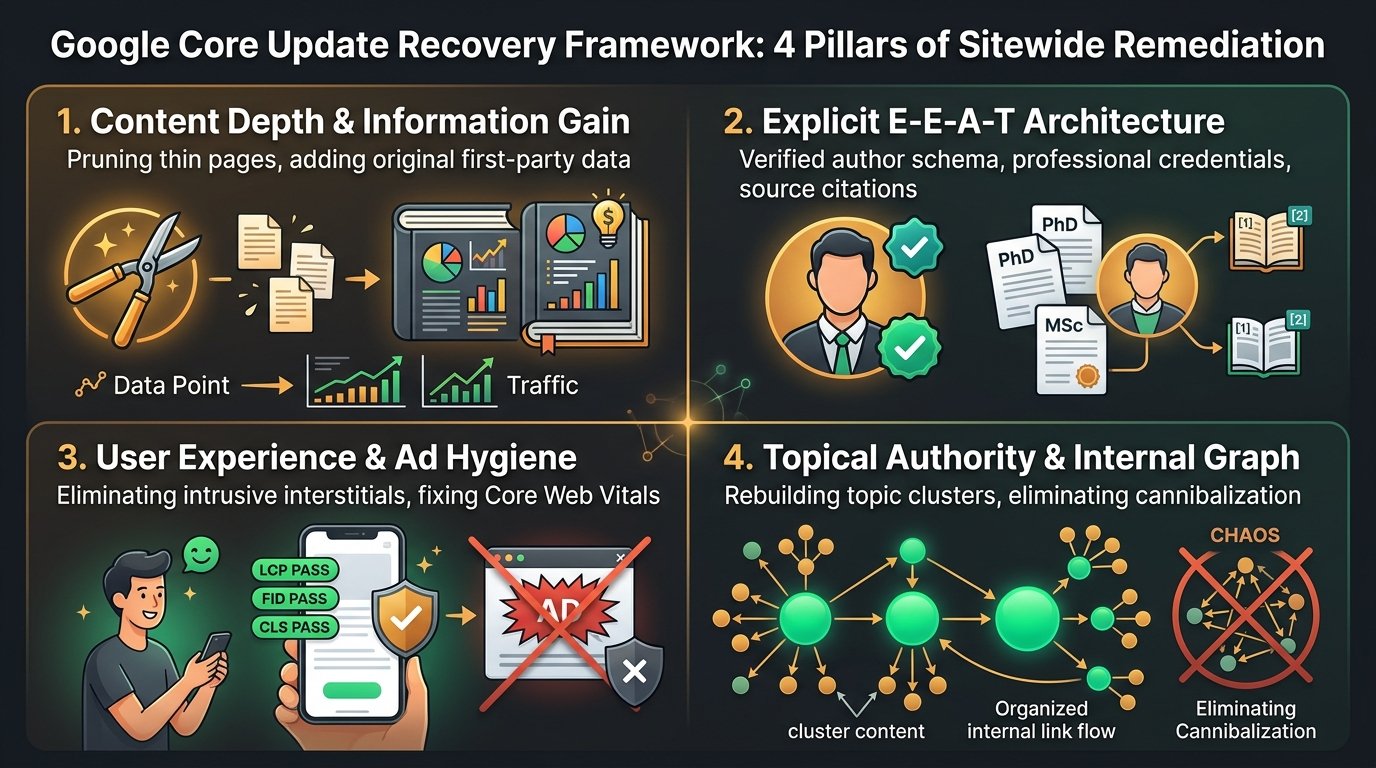
Yes. An audit identifies why Google’s automated systems reclassified your domain, isolating thin content, missing E-E-A-T signals, and user experience issues that need remediation.
6. How much does a professional enterprise SEO audit cost?
Professional one-time audits typically range from ₹40,000 to ₹1,75,000 ($500 to $2,500+ USD) depending on site complexity, as outlined in our transparent SEO pricing guide.
7. What access permissions does an auditor require?
Auditors require read-only access to Google Search Console, Google Analytics 4, and server access logs, along with temporary CMS view access to inspect theme templates.
8. Will an SEO audit fix our website automatically?
An audit provides the diagnostic blueprint and engineering instructions. The fixes must then be deployed either by your internal web developers or by the agency team under an ongoing retainer.
9. How do we choose the right agency to audit our website?
Review our decision-maker guide on how to choose the right SEO agency to vet technical credentials and avoid vendors relying on automated generic checklists.
10. What is the immediate first step after receiving an audit report?
Schedule an alignment call between the SEO auditor and your lead web developers to review P0 critical fixes, address technical questions, and integrate tickets into your upcoming development sprint.
Uncover Your Website’s Growth Potential with SEO Sadhu
Stop guessing why your organic rankings have plateaued. A forensic technical audit gives you the exact blueprint needed to eliminate invisible revenue leaks and outrank your competitors.
At SEO Sadhu, our audits provide granular engineering precision, competitive gap intelligence, and measurable business roadmaps. Ready to uncover what is holding your search performance back? Contact our technical audit team today to schedule your comprehensive forensic site audit.