Waking up to a sudden cliff in organic traffic is an absolute nightmare for any business owner. In minutes, organic leads vanish, revenue forecasts stall, and executive panic sets in. However, rushing into frantic website redesigns or rewriting entire content catalogs without a clear diagnosis often turns a temporary dip into permanent damage.
⚡ Emergency Triage: Organic Traffic Drops
- Rule Out Tracking Glitches First: More than 25% of “traffic drops” are simply broken Google Analytics 4 tags, duplicate consent mode triggers, or tag manager errors.
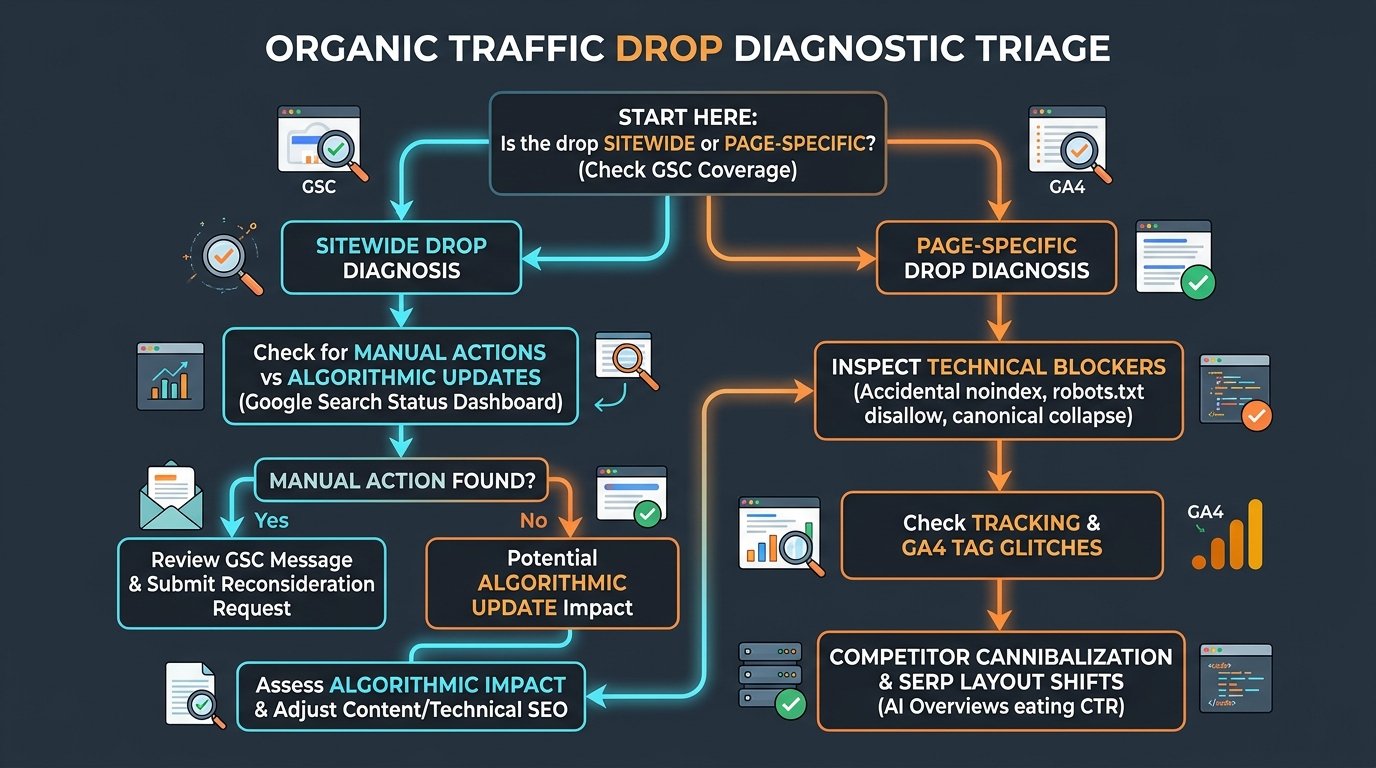
- Check Google Search Console Coverage: Determine immediately whether the drop is sitewide or confined to specific high-traffic URL clusters.
- Verify Crawl Accessibility: Inspect recent CMS code deployments for accidental
noindextags, robots.txt disallows, or canonical collapses using a structured technical SEO checklist. - Account for SERP Layout Shifts: Verify whether impressions stayed stable while CTR fell—a hallmark indicator that Google AI Overviews pushed organic listings below the fold.
- Audit Prior Vendor Work: If you recently used a budget contractor, verify whether they deployed toxic links by reviewing our breakdown of major SEO agency red flags.
At SEO Sadhu, our technical team performs urgent rescue audits for brands facing sudden organic drops. Isolating the root cause methodically separates false alarms from critical algorithmic penalties.
1. The First 60 Minutes: Systematic Triage
When organic traffic drops sharply, emotional reactions lead to poor decisions. Never change URLs, delete pages, or disavow links until you have completed this step-by-step diagnostic workflow:

2. Category 1: Tracking and Tag Configuration Errors
Before assuming Google has penalized your domain, confirm that your measurement setup is functioning properly.
Common tracking failures that mimic severe traffic drops include:
- Unpublished Google Tag Manager Containers: A developer pushed a staging environment live and overwrote the production container ID.
- Cookie Consent Banner Blocking: Misconfigured GDPR or consent mode scripts that prevent GA4 from firing unless visitors manually accept cookies.
- Cross-Domain Tracking Breaks: E-commerce stores that switch checkout domains without configuring referral exclusion lists, causing organic sessions to register as direct or referral traffic.
3. Category 2: Technical Self-Sabotage and Code Deployment Bugs
If Google Search Console also shows an immediate drop in impressions, you are dealing with a genuine search visibility issue rather than an analytics glitch.
The most frequent culprit is accidental technical self-sabotage following a recent website release or CMS update:
- Accidental Staging Directives: Developers accidentally push
<meta name="robots" content="noindex, nofollow">from testing environments directly to live pages. - Faulty Robots.txt Updates: A single line of code (such as
Disallow: /) blocking Googlebot from accessing your primary CSS or page templates. - Self-Referential Canonical Failures: Canonical tags incorrectly pointing all product sub-pages back to the homepage.
Consulting our guide on the responsibilities of an SEO manager emphasizes why strict staging-to-production QA protocols prevent these disasters.
4. Category 3: Google Algorithm Updates and Quality Re-evaluations
If your technical plumbing is immaculate and Googlebot is crawling normally, compare your traffic drop timeline against the official Google Search Status Dashboard.
Google rolls out multiple Core Updates, Helpful Content updates, and Spam updates each year. If your drop coincides with an update rollout, Google’s automated systems have reassessed your site’s overall quality and authority.
In high-stakes commercial sectors—such as analyzing why SEO drives SaaS customer acquisition—algorithmic updates disproportionately penalize domains with unverified author bios, thin AI-generated text, or aggressive affiliate schemes.
5. Category 4: Manual Actions and Security Breaches
A manual action occurs when a human reviewer at Google determines that a website actively violates spam policies. Unlike algorithmic adjustments, manual actions are explicitly notified.
Log in to Google Search Console and check the Security & Manual Actions tab. If a manual penalty is present, you will see a specific violation notice (e.g., Unnatural Inbound Links, Thin Content, or Hacked Site). Resolving a manual penalty requires conducting a full audit, disavowing toxic links, and submitting a formal reconsideration request.
6. Complete 5-Step Recovery Action Plan
Recovering lost organic rankings requires disciplined execution over 60 to 90 days. Execute these five steps in order:
- Isolate Affected URL Segments: In Google Search Console, filter by top losing pages. Determine whether losses are isolated to your blog, product catalog, or service hub.
- Audit Technical Integrity: Run a full Screaming Frog crawl to ensure status codes return clean 200 OK headers and mobile rendering is unimpeded.
- Prune or Upgrade Thin Content: Combine weak, overlapping articles into authoritative resource pillars with high Information Gain.
- Disavow Toxic Backlink Networks: If past vendors bought low-quality link packages, generate a clean disavow file to disconnect manipulative referring domains.
- Build Legitimate E-E-A-T Signals: Strengthen author bios, cite primary industry research, and acquire authoritative brand mentions.
Whether you require emergency rescue consulting across India or specialized local intervention across hubs like Bangalore and Varanasi, our engineering team restores organic equity methodically.
Frequently Asked Questions About Sudden Traffic Drops
1. How do I know if my traffic drop is an algorithm update or a technical bug?
Technical bugs (like a noindex tag) cause immediate, near-total traffic drops within 24 to 48 hours. Algorithmic updates usually roll out over 7 to 14 days and cause gradual or stepwise declines coinciding with official Google announcement dates.
2. Can Google Analytics 4 fail and falsely show zero traffic?
Yes. Missing GTM tags, expired Google Tag configurations, or conflicts with consent management platforms can completely stop data collection even though Googlebot continues to index your website normally.
3. How long does it take to recover from a Google Core Update drop?
Recovering from a core update typically requires waiting until Google’s systems recalculate sitewide quality signals during the next core update rollout, usually taking 3 to 6 months of sustained content and technical improvements.
4. Should I immediately disavow all my backlinks after a drop?
No. Randomly disavowing links can inadvertently strip your domain of legitimate PageRank and worsen your drop. Only disavow backlinks if you have a confirmed manual penalty or undeniable evidence of paid private blog networks.
5. What is the difference between an impression drop and a click drop?
If impressions remain steady but clicks drop, your rankings likely remain intact, but new SERP features—like Google AI Overviews or sponsored ads—are stealing your click-through rate.
6. Can a website redesign cause an organic traffic drop?
Yes. Redesigns frequently cause severe traffic loss if URL structures change without proper 1-to-1 301 redirects, or if new page templates strip out structured heading hierarchies and body content.
7. Where can I check if Google has an active search outage?
Visit the official Google Search Status Dashboard (status.search.google.com). It tracks real-time crawl, indexing, and serving status alerts directly from Google’s engineering team.
8. How much does a professional emergency SEO recovery audit cost?
Emergency forensic audits typically range from ₹40,000 to ₹1,50,000 ($500–$2,000 USD) depending on site complexity, as detailed in our comprehensive SEO pricing guide.
9. How can I protect my website from future traffic drops?
Maintain continuous technical hygiene, diversify internal traffic sources, avoid black-hat link schemes, and partner with a vetted agency using our agency selection guide.
10. Can changing our domain name fix an algorithmic penalty?
No. 301 redirecting an old, penalized domain to a new domain transfers the negative algorithmic signals and historical spam associations directly to the new URL.
Recover Your Organic Rankings with SEO Sadhu
A sudden drop in organic traffic is alarming, but it is not irreversible. With systematic forensic auditing, technical remediation, and disciplined content enhancement, your domain can reclaim lost visibility.
At SEO Sadhu, we specialize in forensic recovery audits and high-impact SEO restoration. Facing an unexplained traffic drop? Contact our technical recovery team today for an immediate diagnostic assessment.