Google Core Updates do not target specific websites out of spite; they reset algorithmic baselines across the global search index. When your organic impressions drop by 30% to 60% following a core rollout, Google’s machine learning systems have determined that competing pages offer superior Information Gain, user trust, and topical depth.
⚡ Key Takeaways: Core Update Recovery
- Not a Manual Penalty: Core update drops do not come with a manual penalty notice in Google Search Console. They represent a sitewide quality score recalibration.
- Prune Thin & Recycled Content: Content that merely summarizes other search results without adding first-party data is systematically demoted by helpful content classifiers.
- Harden Author E-E-A-T Schema: Build explicit entity validation by connecting author profiles to verified industry sources using structured JSON-LD markup.
- Eliminate Technical Drag: Ensure Core Web Vitals pass mobile thresholds and eliminate crawl bloat using our actionable technical SEO checklist.
- Prepare for the Next Cycle: Core update recoveries rarely happen overnight. Substantial rank restoration occurs when Google recalculates sitewide quality during the subsequent core rollout.
At SEO Sadhu, we have engineered recoveries for dozens of enterprise domains following major algorithmic updates. Recovering requires moving beyond superficial tweaks and implementing genuine, sitewide content and architectural improvements.
1. Algorithmic Reassessment vs Manual Action: What Actually Happened?
The first step in recovery is understanding the mechanism behind your traffic loss. Many business owners confuse an algorithmic adjustment with a manual webspam penalty.

If your drop coincided with an announced Google Core Update, your site was not singled out by a manual reviewer. Google’s automated machine learning classifiers reassessed your entire domain against its Search Quality Rater Guidelines, rewarding competitors who demonstrate superior first-party expertise.
Before making radical changes, cross-reference your traffic drop using our triage guide on why organic traffic drops suddenly to confirm the timing matches official update windows.
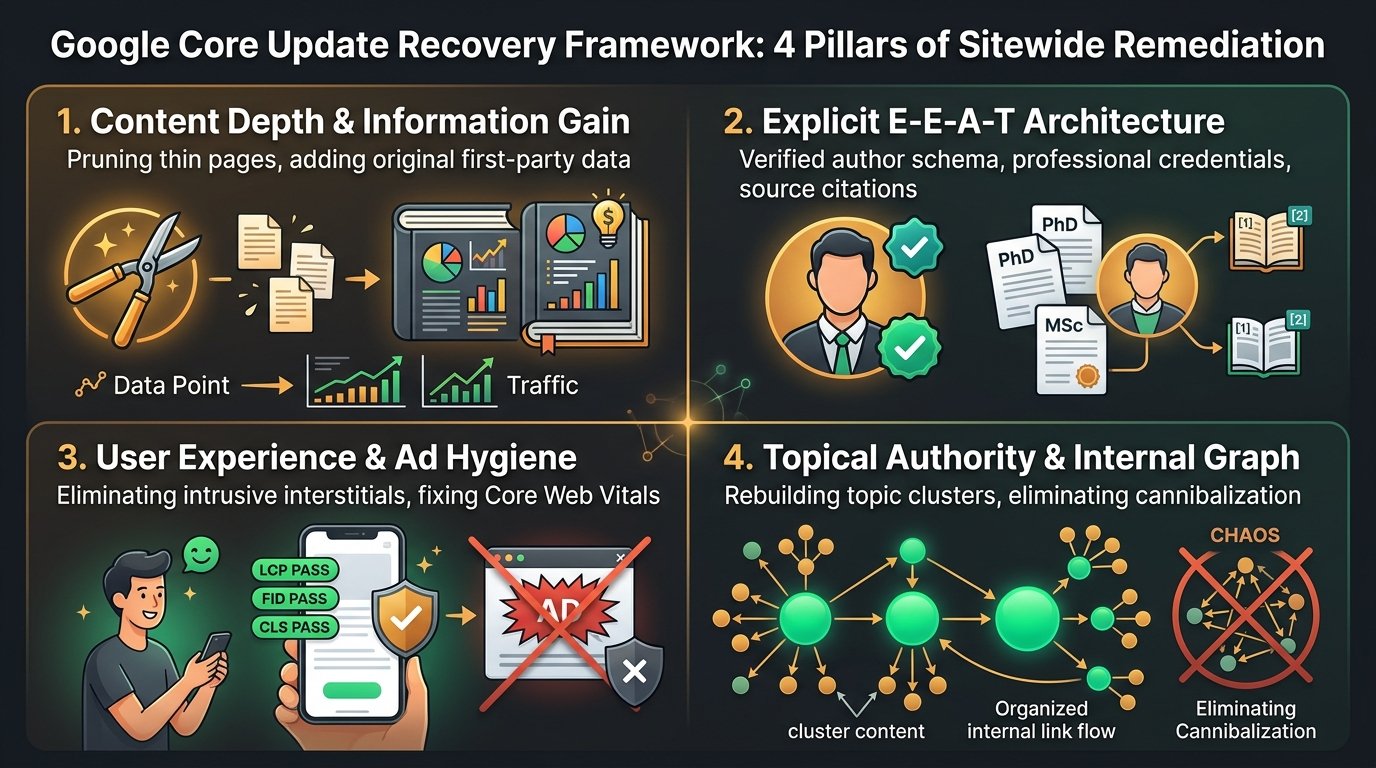
2. The 4 Pillars of Sitewide Remediation
Fixing individual title tags will not rescue a penalized domain. Google evaluates quality holistically across your entire URL catalog.
3. Pillar 1: Content Depth & Information Gain Audits
Google’s helpful content algorithms actively devalue “search engine first” content. If an article merely rehashes existing ranking pages without offering original perspectives, it provides zero Information Gain.
Execute an aggressive content audit across all indexed URLs:
- Delete or 410 Unsalvageable Content: Completely remove thin, outdated, or AI-generated articles that receive zero traffic and zero backlinks.
- Consolidate Overlapping Topics: Merge three or four shallow articles into one comprehensive, authoritative pillar guide.
- Inject Proprietary Case Studies: Add first-party testing data, client benchmarks, and original quotes that cannot be found anywhere else on the web.
4. Pillar 2: Explicit E-E-A-T Entity Architecture
Experience, Expertise, Authoritativeness, and Trustworthiness (E-E-A-T) are mathematical entity relationships in Google’s Knowledge Graph.
To demonstrate verified authority, your website must implement transparent entity signals:
- Verified Author Bylines: Every informational article must be attributed to a real practitioner with published professional credentials.
- SameAs Schema Mapping: Connect author profiles to their verified LinkedIn, Wikipedia, and industry publications using structured JSON-LD schema.
- Clear Editorial Standards: Publish transparent editorial policies, medical/legal review statements, and complete organizational contact details.
Reviewing our analysis of the responsibilities of an SEO manager highlights why content governance and entity verification protect domains from update fallout.
5. Pillar 3: User Experience, Layout, & Ad Hygiene
Aggressive monetization often triggers core update demotions. If your content is obscured by intrusive popups, sticky video ads, or shifting layout elements, Google’s automated systems downgrade your site’s perceived quality.
Conduct a thorough user experience audit to ensure content is immediately accessible upon page load. Furthermore, aligning your layout for modern search features—such as formatting content for Google AI Overviews—improves extraction quality for both automated models and human readers.
6. Pillar 4: Eliminating Keyword Cannibalization & Hub Structure
When multiple pages on your website target identical search intent, they cannibalize each other’s authority, confusing Google’s ranking systems.
Organize your content into clear hub-and-spoke topic clusters. Consolidate competing URLs and establish clear internal linking hierarchies so search crawlers recognize which page serves as the definitive topical authority.
Whether you require emergency algorithm recovery across India or targeted guidance from our specialists in Bangalore and Varanasi, our forensic process restores domain trust.
Frequently Asked Questions About Google Core Update Recovery
1. How long does it take to recover from a Google Core Update?
Recovery requires Google to recalculate sitewide quality signals during the next official Core Update, which typically occurs every 3 to 6 months. Changes made today build the foundation for recovery during the subsequent update rollout.
2. Can I submit a reconsideration request after a Core Update drop?
No. Reconsideration requests only apply to manual webspam penalties displayed in Google Search Console. Core updates are entirely automated algorithmic recalculations with no manual appeal process.
3. Should I delete articles that lost traffic during the update?
Yes. Pruning or consolidating low-quality, zero-traffic URLs removes “quality drag” from your domain. Deleting thin pages allows Googlebot to allocate crawl budget to your highest-performing assets.
4. Does changing our website theme help recover lost rankings?
Only if your old theme suffered from severe Core Web Vitals failures, excessive JavaScript bloat, or poor mobile rendering. Changing aesthetics alone will not fix fundamental content quality or trust deficiencies.
5. Why did AI-generated content get hit so hard in recent updates?
Google’s helpful content algorithms target mass-produced content created solely to manipulate search rankings without first-party human experience. Adding proprietary research, case studies, and unique analysis is essential.
6. Can toxic backlinks cause a Core Update drop?
Core updates focus primarily on content quality and user satisfaction rather than link spam. However, if past vendors built manipulative link networks, reviewing major agency red flags and filing a selective disavow file may be necessary.
7. How do I know if my competitors were also affected?
Monitor third-party visibility trackers (Semrush Sensor, Rank Ranger) and check whether competing domains in your niche saw similar ranking drops or if specific authoritative competitors absorbed your lost rankings.
8. How much does an enterprise Core Update recovery audit cost?
Comprehensive algorithmic recovery audits typically range from ₹50,000 to ₹1,80,000 ($600 to $2,200 USD) depending on catalog size, as detailed in our transparent SEO pricing guide.
9. Can a website recover 100% of its former organic traffic?
Yes. Many sites that comprehensively overhaul their content, prune thin URLs, and establish verified E-E-A-T signals not only recover their previous traffic but exceed their historical all-time highs.
10. What is the single most important action to take after a core update drop?
Be objective. Audit your top losing pages against the current top-ranking competitors. Identify where their content offers clearer data, better user experience, or stronger author credentials, and systematically upgrade your pages to exceed their standard.
Rebuild Your Search Authority with SEO Sadhu
An algorithmic drop is a signal that your website’s content strategy needs to evolve. With rigorous forensic analysis and disciplined execution, you can transform a setback into sustainable competitive advantage.
At SEO Sadhu, we specialize in forensic recovery audits, content pruning, and authoritative search rebuilding. Impacted by a recent Google update? Contact our recovery specialists today to request an in-depth algorithmic impact audit.