
Most B2B SaaS companies treat organic search like a vanity volume contest. They publish dozens of generic top-of-funnel glossaries and definition posts that generate hundreds of thousands of monthly pageviews, yet their sales development reps sit on empty demo calendars.
⚡ Key Takeaways: Scaling SaaS Pipeline via SEO
- Invert the Funnel: Stop prioritizing high-volume definition keywords. Build Bottom-of-Funnel (BOFU) comparison and alternative pages where conversion rates reach 4% to 8%.
- Product-Led Content Integration: Don’t isolate your software behind generic signup buttons. Embed your actual product interface and UI workflows directly into problem-solving tutorials.
- Safeguard App Crawl Budget: Separate your marketing website from your software application subdomains to avoid burning crawl budget, as detailed in our technical SEO checklist.
- Optimize for LLM Engines: Modern buyers evaluate B2B software inside ChatGPT and Perplexity. Structure your brand entities so you earn top citations in Google AI Overviews.
- Align with Growth Retainers: Explore transparent monthly investment tiers in our comprehensive SEO pricing guide to match marketing budget with customer lifetime value.
At SEO Sadhu, we partner with enterprise software companies and high-growth venture-backed SaaS startups. Shifting your strategy from empty vanity clicks to high-intent buyer queries transforms organic search into a reliable pipeline engine.
1. The Vanity Traffic Trap in B2B SaaS
Many SaaS marketing teams boast about doubling organic sessions, but fail to explain why customer acquisition cost (CAC) remains high. In organic search, not all traffic is created equal.

A blog post titled “What is Project Management?” might generate 50,000 monthly visits from college students and casual researchers, converting at a dismal 0.1%. Conversely, a comparison page targeting “Best Enterprise Asana Alternatives for Agile Dev Teams” might only receive 300 monthly visits, but converts at 6.5% into booked sales demos.
As explored in our foundational analysis of why SEO drives SaaS customer acquisition, capturing prospects during active software evaluation yields compounding business value.
2. Inverting the SaaS SEO Funnel
Traditional marketing advises starting at the broad top of the funnel and slowly nurturing leads down. In B2B SaaS, you should invert this hierarchy entirely:
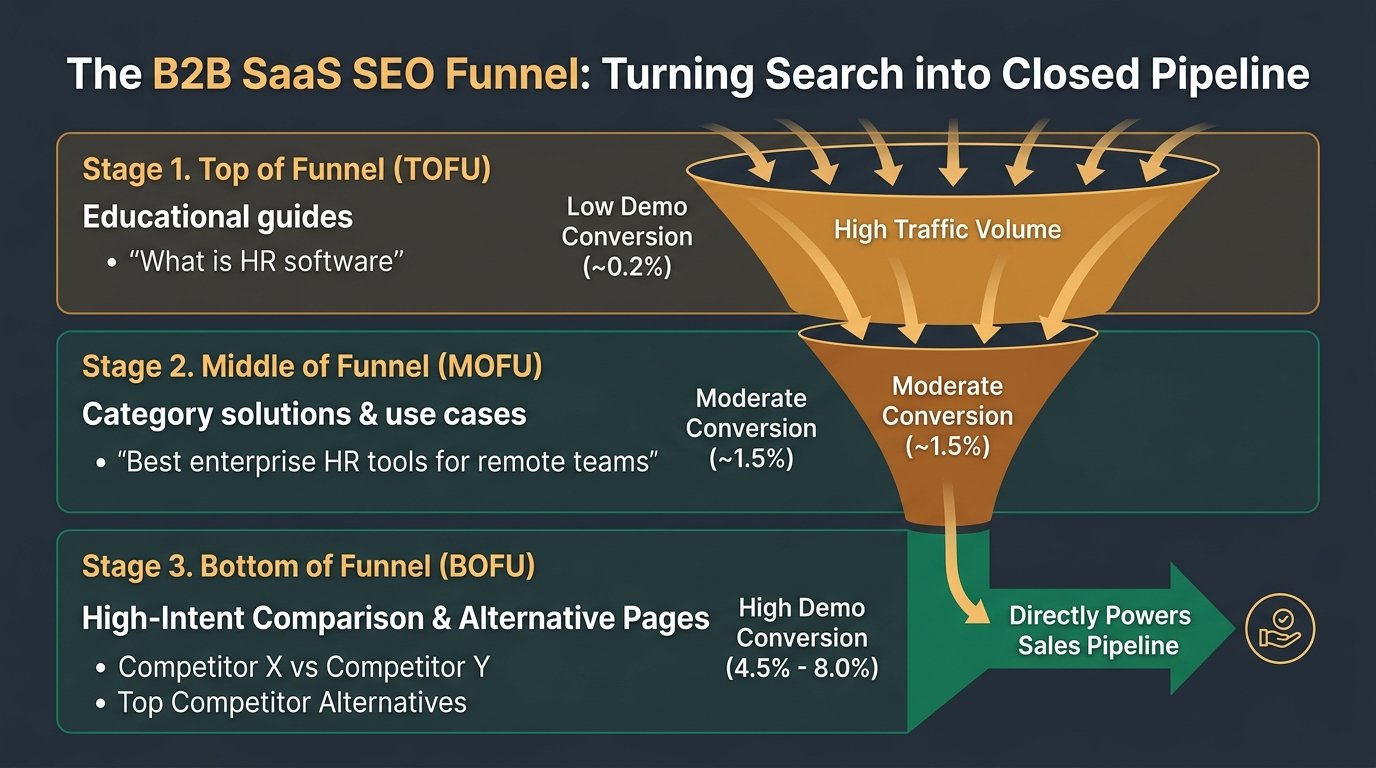
Here is how to allocate your content production bandwidth across the funnel:
| Funnel Stage | Target Query Syntax | Demo Conversion Rate | Strategic Role |
|---|---|---|---|
| Bottom of Funnel (BOFU) | “[Competitor] Alternatives”, “[Brand A] vs [Brand B]”, “Best [Category] Software” | 4.0% – 8.5% | Captures active buyers with ready budget; primary driver of qualified sales demos. |
| Middle of Funnel (MOFU) | “How to Automate [Workflow]”, “[Industry] Compliance Templates”, “Use Case Guides” | 1.0% – 2.5% | Educates decision-makers on software category solutions; drives free trial signups. |
| Top of Funnel (TOFU) | “What is [Concept]?”, “[Industry] Trends”, “Definitions & Glossaries” | 0.1% – 0.4% | Builds topical authority and brand awareness; captures newsletter subscribers. |
When vetting prospective agency partners using our guide on how to choose the right SEO agency, ensure they prioritize commercial intent over vanity keyword counts.
3. High-Converting Comparison & Alternative Page Architecture
Alternative and comparison pages are the highest-ROI assets in your SaaS content library. Buyers typing these terms into search engines are at the very point of decision.
To win rankings and drive conversions, structure your comparison pages with complete editorial objectivity:
- Feature Matrix Tables: Present clear, scannable comparison tables that honestly detail strengths, limitations, and pricing tiers.
- Ideal Customer Profile Segmentation: Explain exactly who your competitor is best suited for (e.g., enterprise legacy teams) and who your platform serves best (e.g., fast-moving startups).
- First-Party Screenshots: Showcase real application UI workflows rather than generic promotional stock images.
4. Product-Led Content: Demonstrating Value Inside Articles
Generic call-to-action banners that say “Sign Up for a Free Trial” at the end of a 3,000-word blog post no longer work. Modern buyers want to see software in action before initiating contact.
Product-led content integrates your software directly into the educational solution. If your article explains “How to Reconcile Multi-Currency Invoices,” show how your platform’s automated reconciliation engine executes that exact task in two clicks.
Understanding the internal division of labor between in-house marketing teams and specialized agencies ensures your product marketing managers collaborate seamlessly with technical SEO copywriters.
5. Technical SEO Guardrails for SaaS Web Applications
Software-as-a-Service platforms present unique technical search challenges. Because SaaS companies frequently host web applications, documentation hubs, and marketing sites on interconnected subdomains, crawl bloat can occur rapidly.
Implement these technical guardrails to protect your organic visibility:
- Keep Marketing on the Root Domain: Host your marketing blog on
/blograther than a separate subdomain (blog.domain.com) to consolidate link equity. - Noindex App Dashboards: Block search engines from crawling authenticated web app routes (
app.domain.comor/dashboard) via robots.txt to conserve crawl budget. - Pre-Render Dynamic JavaScript: Ensure client-side rendered Single Page Applications (React, Vue, Next.js) utilize Server-Side Rendering (SSR) so search bots receive fully rendered HTML.
Reviewing the defined responsibilities of an SEO manager reinforces why technical web architecture is just as critical as editorial writing.
Whether scaling software brands across India or targeting competitive international markets through regional hubs like Bangalore and Varanasi, technical precision accelerates organic growth.
Frequently Asked Questions About B2B SaaS SEO
1. How long does it take for a B2B SaaS company to see SEO results?
Bottom-of-funnel comparison and alternative pages often generate qualified demo requests within 60 to 90 days of indexation. Broad category keywords and topical authority hubs typically require 6 to 9 months of consistent publication.
2. Why shouldn’t a SaaS company host their blog on a subdomain?
Search engines treat subdomains as separate web entities. Hosting your blog on a subfolder (domain.com/blog) shares domain authority and PageRank directly with your high-value product landing pages.
3. How do we measure SEO success beyond organic traffic volume?
Measure pipeline metrics: Marketing Qualified Leads (MQLs), Sales Qualified Leads (SQLs), demo conversion rate, Customer Acquisition Cost (CAC), and Annual Contract Value (ACV) originating from organic search.
4. Can SaaS companies rank for competitor brand names legally?
Yes. Creating honest, objective comparison and alternative pages (“Competitor X vs Competitor Y”) is standard practice and legally protected under fair use, provided you do not make false claims or infringe trademarks in ad copy.
5. What is the role of AI search in B2B SaaS buyer journeys?
B2B software evaluators increasingly ask ChatGPT and Google AI Overviews to recommend software tools. Implementing entity schema and earning citations on authoritative review sites ensures your software gets recommended.
6. How many blog posts should a B2B SaaS company publish per month?
Quality and commercial intent vastly outperform quantity. Publishing 4 to 8 deeply researched, product-led articles per month produces far more qualified demos than churning out 30 shallow, automated articles.
7. Should we gate our best content behind email capture forms?
No. Gating content hides it from search engine crawlers, destroying its organic ranking potential. Keep your educational content open to maximize search traffic, and place demo and trial offers strategically within the text.
8. What is the average cost of specialized B2B SaaS SEO agency services?
Dedicated SaaS SEO retainers typically range from ₹1,00,000 to ₹3,00,000+ ($1,500 to $4,000+ USD) per month, depending on competitive landscape and technical complexity.
9. How do we prevent our SEO traffic from dropping during a platform migration?
Follow our comprehensive website migration SEO checklist to map 1-to-1 redirects and preserve URL equity when updating your SaaS marketing CMS.
10. What should we do if our SaaS organic traffic drops suddenly?
Conduct an immediate diagnostic triage using our guide on why organic traffic drops suddenly to isolate whether the issue is a tracking bug, algorithm update, or technical deployment error.
Accelerate Your SaaS Pipeline with SEO Sadhu
Stop chasing empty organic pageviews that fail to move the revenue needle. It is time to turn your website into your highest-performing inbound sales development channel.
At SEO Sadhu, we engineer high-converting B2B SaaS search strategies that capture in-market buyers and fuel predictable software revenue. Ready to scale your demo pipeline? Contact our SaaS growth strategists today to schedule an exploratory consultation.