
For large-scale retail brands, organic search represents the lifeblood of sustainable digital sales. Yet, as e-commerce catalogs scale into tens of thousands of SKUs, an invisible technical disease takes hold: index bloat caused by unmanaged faceted navigation and parameter variations.
⚡ Key Takeaways: Enterprise E-Commerce SEO
- The Multiplier Effect: Combining 5 filter attributes (size, color, brand, price, rating) can explode a 5,000-product catalog into more than 1,000,000 low-value parameter URLs.
- Crawl Budget Cannibalization: When Googlebot wastes bandwidth crawling infinite filter permutations, high-margin new product releases remain unindexed for weeks.
- Strategic Filter Indexation: Identify high-volume category attribute pairings (e.g., “Red Running Shoes”) and generate static, canonicalized URLs while blocking low-value filter combinations.
- Technical Health Auditing: Eliminate indexing traps by reviewing your server response codes with our comprehensive technical SEO checklist.
- Protect Seasonal Equity: Never delete discontinued product URLs without proper 301 redirects, or you risk the sudden traffic losses outlined in our traffic drop recovery framework.
At SEO Sadhu, we engineer technical search architectures for enterprise retailers and fast-scaling D2C marketplaces. Taming faceted navigation and eliminating index bloat ensures search engines focus exclusively on high-converting product and category pages.
1. How Faceted Navigation Destroys E-Commerce Crawl Efficiency
Faceted navigation is essential for human shoppers. Allowing users to filter shirts by size, color, collar type, and price creates a seamless shopping experience.

However, from a search crawler’s perspective, dynamic URL parameters create an infinite maze. When every filter combination generates a new URL string (/category?color=blue&size=large&sort=price_desc), search engines encounter millions of near-duplicate pages carrying zero unique value.
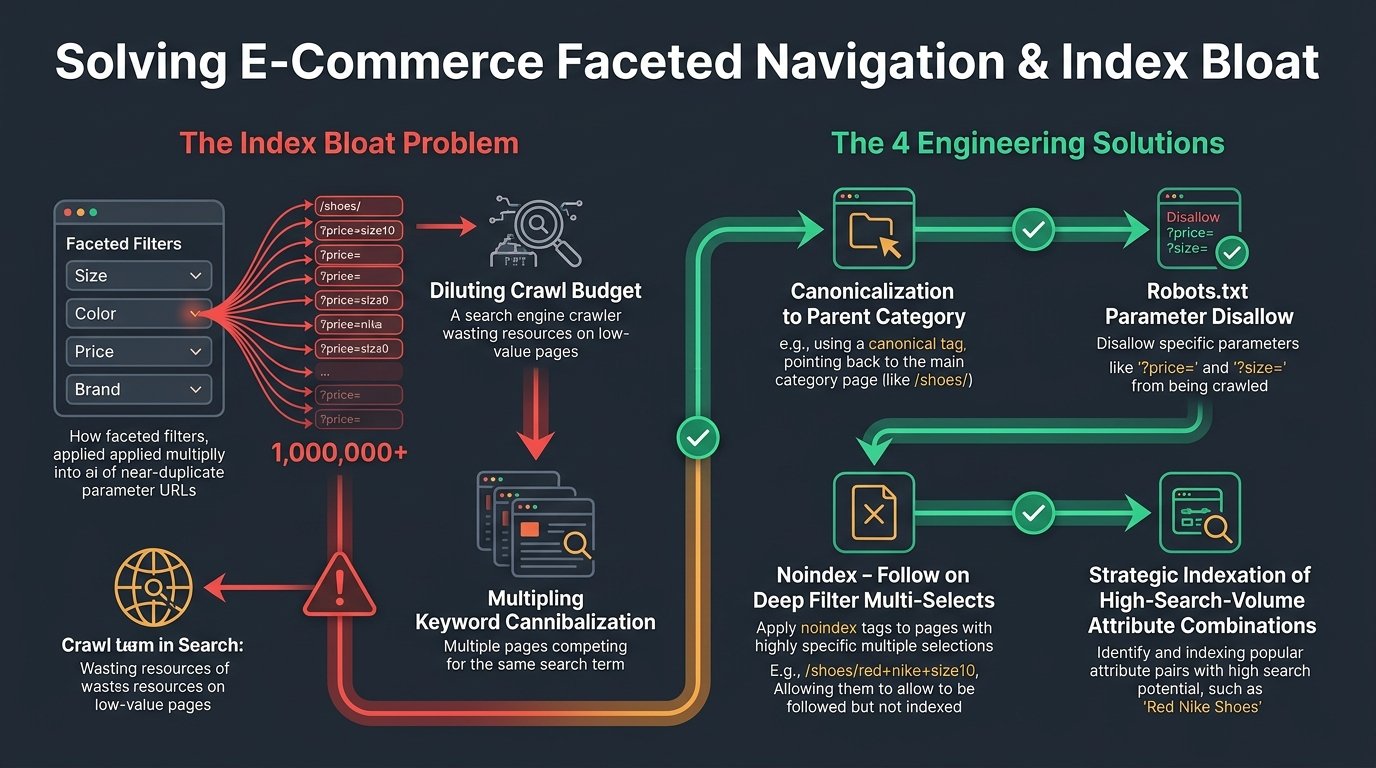
2. Four Engineering Solutions for Managing Faceted Filters
Eliminating index bloat without hurting user experience requires deploying a layered technical strategy across your e-commerce platform:
| Engineering Method | How It Works Technically | Best Practical Use Case |
|---|---|---|
| Canonicalization to Parent | Add rel="canonical" on filtered pages pointing back to the root category URL. |
Sorting filters (price, date, newest), pagination parameters. |
| Robots.txt Parameter Disallow | Block crawler access using wildcards: Disallow: /*?*price=. |
Non-commercial tracking, session IDs, internal search results. |
| Noindex, Follow Directives | Add <meta name="robots" content="noindex, follow"> to deep multi-selects. |
Deep multi-attribute combinations (e.g., color + size + brand). |
| AJAX / PushState Facets | Update product grids client-side via JavaScript without generating crawlable HTML links. | Modern single-page retail storefronts (Shopify Plus, Headless). |
When auditing potential agency partners with our guide on how to choose the right SEO agency, ensure their technical team possesses hands-on experience modifying enterprise CMS routing.
3. Strategic Facet Indexation: Capturing High-Intent Long-Tail Clicks
Not all faceted pages should be blocked. Some filter combinations have massive search demand that represents high-converting organic revenue.
For example, while /shoes?size=11&color=black&brand=nike should be canonicalized or blocked, the query “Black Nike Running Shoes” has thousands of monthly commercial searches. Rather than serving this query with a parameter URL, generate a static, clean subcategory URL (/shoes/nike/black-running/) with custom H1 headers and unique introductory copy.
As covered in our playbook on B2B search funnels, targeting exact buyer intent accelerates conversion rates across any digital catalog.
4. Managing Out-of-Stock and Discontinued Product URLs
One of the largest leaks of domain authority in e-commerce occurs when products sell out. Inexperienced store managers simply delete the page, creating thousands of 404 errors that destroy historical link equity.
Implement this standard protocol for inventory changes:
- Temporarily Out of Stock: Keep the URL active with a 200 OK status code. Display a clear “Out of Stock” badge, capture email notifications, and recommend related products.
- Permanently Discontinued with a Direct Successor: Implement a 301 redirect pointing the old SKU URL directly to the updated product version.
- Permanently Discontinued without Replacement: 301 redirect the dead URL to the closest relevant subcategory page to preserve accumulated PageRank.
Following our pre-launch protocols in the website migration SEO checklist guarantees that catalog updates never trigger index drops.
5. Product & AggregateOffer Schema Architecture
E-commerce search results are increasingly visual and interactive. Utilizing structured JSON-LD markup helps your products claim rich snippets with review stars, stock status, and pricing.
Implement comprehensive Product and AggregateOffer schema containing verified SKU numbers, GTIN identifiers, high-res image arrays, and merchant return policies. Validating this schema directly reinforces your brand’s authority inside emerging search interfaces like Google AI Overviews.
Reviewing the defined responsibilities of an SEO manager emphasizes why structured data governance is a primary driver of organic conversion rates.
Whether scaling an enterprise marketplace across India or consulting with local commercial specialists in Bangalore and Varanasi, technical precision unlocks retail revenue.
Frequently Asked Questions About Enterprise E-Commerce SEO
1. What is index bloat in e-commerce?
Index bloat occurs when search engines index hundreds of thousands of low-value, duplicate, or thin parameter URLs (such as faceted filters, search queries, and sorting variations) instead of focusing on unique, high-margin product pages.
2. Should I use robots.txt to block all faceted filter parameters?
Be careful. If Google has already indexed those parameter URLs, adding a robots.txt disallow prevents Googlebot from re-crawling them to see subsequent noindex or canonical tags, leaving the duplicate URLs stuck in the search index.
3. How does canonicalization solve duplicate content across color variants?
If you sell a shirt available in 6 colors with identical product descriptions, designating one primary color URL as the canonical version consolidates ranking signals into a single authoritative page while avoiding cannibalization.
4. What should we do with expired seasonal holiday category pages?
Keep the URL alive (e.g., /black-friday-deals) year-round. Update the content with an email waitlist between seasons to retain the page’s accumulated backlink authority and organic age.
5. Can internal site search results be indexed by Google?
No. Indexing internal search result pages violates Google’s Webmaster Guidelines and creates massive index bloat. Always block internal search paths (e.g., /search?q=) via robots.txt or noindex directives.
6. How do we choose between an in-house SEO team and an agency for e-commerce?
Review our financial comparison on in-house teams vs agency retainers. Many retailers maintain an in-house content team while hiring a technical agency to manage crawl efficiency and faceted routing.
7. What are the typical agency retainer costs for enterprise e-commerce SEO?
Enterprise e-commerce retainers typically range from ₹1,00,000 to ₹3,50,000+ ($1,500 to $5,000+ USD) monthly, as outlined in our transparent SEO pricing guide.
8. How does site speed affect e-commerce search rankings and sales?
Every 100ms improvement in page speed increases conversion rates by up to 1%. Furthermore, passing Core Web Vitals is a confirmed mobile ranking factor that directly impacts category visibility.
9. How do we prevent keyword cannibalization across similar product categories?
Map distinct, non-overlapping search intent to each category URL. For example, differentiate “Men’s Leather Boots” from “Men’s Work Boots” through clear heading hierarchies, distinct filter options, and tailored internal links.
10. What is the fastest way to identify how many pages Google has indexed?
Perform a site:yourdomain.com search in Google or inspect the Page Indexing report inside Google Search Console. If your indexed URL count vastly exceeds your total active product and category count, you have index bloat.
Maximize Your E-Commerce Revenue with SEO Sadhu
Don’t let technical index bloat and unmanaged parameter filters silently bleed your organic revenue. Your product catalog deserves flawless crawl efficiency and dominant category rankings.
At SEO Sadhu, we specialize in technical e-commerce search engineering, faceted navigation optimization, and high-converting retail taxonomy. Ready to optimize your online catalog? Contact our enterprise e-commerce team today to schedule an in-depth architectural audit.