For Chief Financial Officers and growth leaders, marketing investments cannot hide behind vague promises of “brand awareness.” While search engine optimization historically suffered from opaque reporting, calculating the concrete return on investment (ROI) of organic search is entirely quantifiable when grounded in revenue attribution.
⚡ Key Takeaways: Executive SEO ROI
- The Core Formula: Calculate SEO ROI as:
(Gross Organic Revenue - Total SEO Spend) / Total SEO Spend × 100. - Account for Compounding Equity: Unlike paid advertising where traffic immediately drops to zero when ad spend stops, organic assets continue generating pipeline years after publication.
- Track Blended CAC Reduction: Organic search acts as an efficiency multiplier, significantly lowering blended Customer Acquisition Costs (CAC) across paid channels.
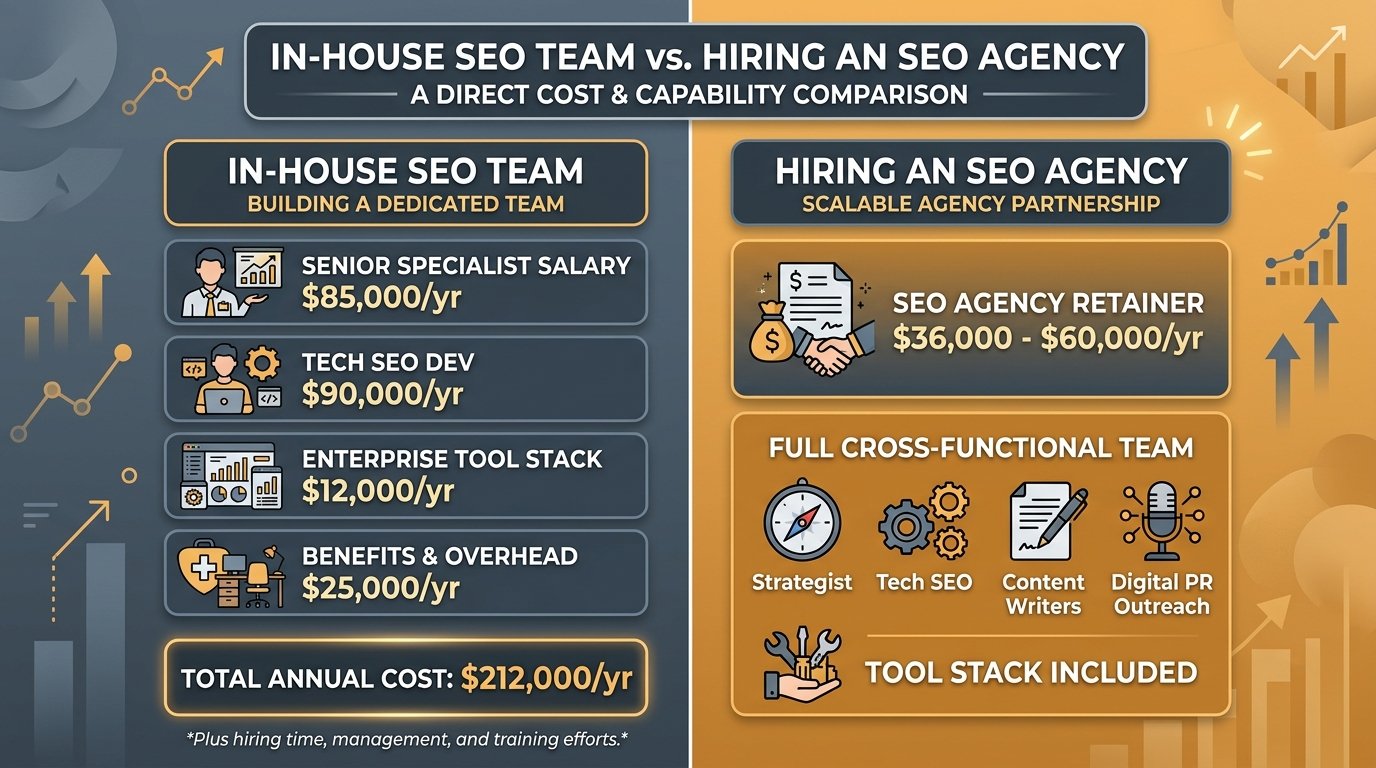
- Compare Against Headcount Overhead: Factor in the substantial cost savings of agency partnerships detailed in our in-house team vs agency comparison.
- Benchmark Retainers Accurately: Ensure your investment models align with realistic market rates from our comprehensive SEO pricing guide.
At SEO Sadhu, we build organic campaigns engineered around pipeline generation and revenue contribution. Demystifying the financial mathematics armors marketing directors with the justification needed to secure executive buy-in.
1. The Financial Formula for Measuring SEO ROI
To present a compelling business case to executive leadership, you must isolate the direct financial contribution of search engine optimization from generic marketing overhead.

Use this standardized mathematical framework to calculate your net organic search return:
Where total investment encompasses:
- Agency monthly retainer fees or internal salary allocation.
- Enterprise software licensing (Ahrefs, Semrush, Screaming Frog).
- Web development implementation hours and content asset production.
2. The Compounding Advantage: SEO vs Paid Search Economics
The primary economic distinction between paid advertising (PPC) and organic search lies in asset depreciation. Paid search functions like renting real estate; organic search functions like building equity.
Consider the economic divergence between paid customer acquisition and organic compounding over a 24-month horizon:
| Channel Dynamic | Paid Advertising (Google Ads) | Organic Search (SEO) |
|---|---|---|
| Cost Structure | Linear marginal cost per click; costs increase as auctions become competitive. | Fixed retainer cost; marginal cost per click decreases as rankings compound. |
| Traffic Durability | Immediate collapse to zero the moment budget is exhausted. | Persistent equity; high-ranking pages continue driving pipeline for years. |
| Conversion Trust | Lower average trust; ad fatigue and ad-blockers impact reach. | High organic authority; perceived as unbiased editorial recommendations. |
| Long-Term ROI Multiple | Flat (typically 1.5x to 2.5x ROAS). | Compounding (often exceeding 5x to 12x net ROI by Year 2). |
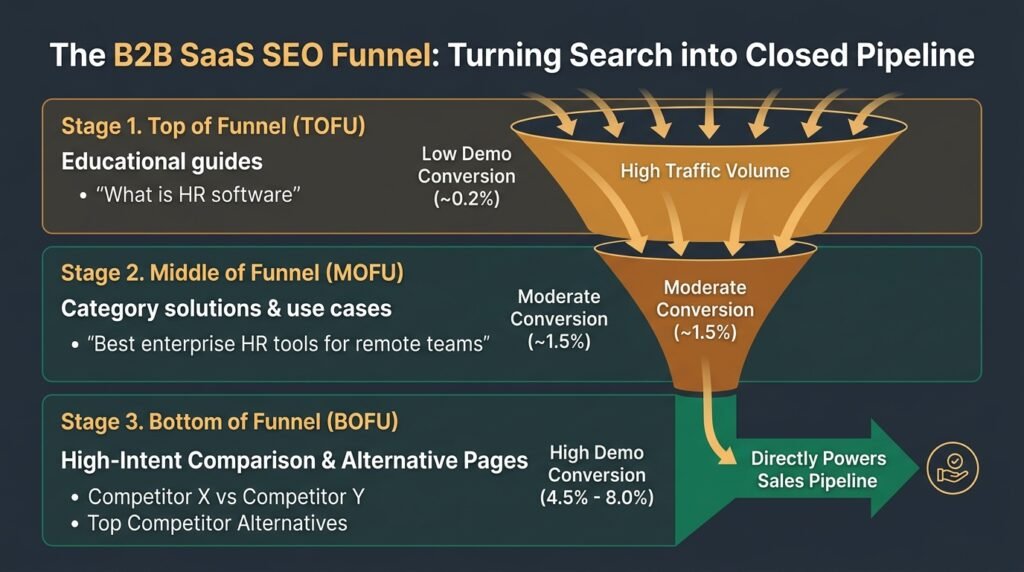
In high-velocity commercial sectors—such as our enterprise software clients deploying our B2B SaaS SEO playbook—organic search becomes the most profitable acquisition channel in the company’s financial model.
3. Attribution Modeling: First-Touch vs Multi-Touch
Modern B2B purchasing decisions rarely happen in a single browser session. A prospect might discover your brand through an informational blog post, return two weeks later via a retargeting ad, and finally book a sales demo through a branded search query.
If your analytics team relies solely on “Last-Click Attribution,” your reporting will mistakenly credit the final branded search, completely erasing the organic search contribution that initiated the relationship.
To accurately capture organic ROI, configure Data-Driven or Multi-Touch Attribution inside Google Analytics 4. Furthermore, tracking assisted conversions and pipeline velocity demonstrates how organic visibility shortens sales cycles across every marketing touchpoint.
4. Protecting Your ROI from Algorithmic Disruption
Calculating strong projected returns is meaningless if technical negligence exposes your site to catastrophic traffic drops.
To safeguard your organic revenue stream:
- Conduct Regular Technical Audits: Audit site speed and schema markup using our actionable technical SEO checklist.
- Avoid Toxic Vendor Shortcuts: Protect your domain from the predatory link networks detailed in our guide to major agency red flags.
- Prepare for CMS Upgrades: Follow our four-phase website migration SEO checklist whenever redesigning page templates.
Reviewing the designated responsibilities of an SEO manager emphasizes why technical risk mitigation is an essential component of revenue forecasting.
Whether scaling national e-commerce catalogs across India or working with regional specialists in Bangalore and Varanasi, establishing clear financial benchmarks maximizes marketing impact.
Frequently Asked Questions About Calculating SEO ROI
1. What is considered a good return on investment for SEO?
A good SEO ROI typically falls between 400% and 800% (a 4x to 8x multiple on total spend) over a 12-to-24 month period. Highly scalable business models like B2B SaaS and enterprise e-commerce often achieve multiples exceeding 10x.
2. How long does it take for SEO to become cash-flow positive?
Most organizations break even on their organic search investment between months 6 and 9. By months 12 to 18, accumulated rankings and organic backlinks begin generating compounding profit margins with low marginal cost.
3. How do we track organic revenue for lead generation websites?
Assign monetary value to closed leads. Multiply your total organic form submissions by your sales team’s lead-to-close conversion rate, then multiply by your average customer deal size to determine gross organic revenue contribution.
4. Does SEO ROI include customer lifetime value (LTV)?
Yes. In subscription and recurring-revenue businesses, factoring in Customer Lifetime Value (LTV) rather than just initial purchase value provides an accurate reflection of total revenue generated by organic acquisitions.
5. Why do some executives view SEO as an unmeasurable cost center?
Inexperienced agencies historically reported on vanity keyword impressions rather than pipeline revenue. Implementing conversion tracking, CRM attribution, and revenue reporting transforms SEO into a quantifiable growth channel.
6. How does organic search lower blended Customer Acquisition Cost (CAC)?
As organic search drives a growing percentage of total monthly inbound leads at a fixed retainer cost, the blended acquisition cost across all channels (paid social, Google Ads, display) drops significantly.
7. How do we factor agency fees vs in-house salaries into ROI models?
Consult our detailed breakdown on in-house teams vs agency retainers. Ensure you include benefits, payroll taxes, and software tooling ($12,000+/yr) when evaluating in-house costs.
8. Can an SEO agency guarantee a specific dollar return on investment?
No. Ethical agencies cannot guarantee specific financial returns because external variables—such as sales team closing ability, product pricing, and market competition—influence final closed revenue.
9. How do we calculate the ROI of an emergency recovery audit?
Compare the cost of the forensic audit against the projected revenue lost during continued traffic suppression, using our diagnostic framework on why organic traffic drops suddenly.
10. What metrics should marketing directors report to the board?
Focus on three primary executive metrics: Organic Pipeline Generated, Cost Per Organic Acquisition (CPA), and Total Net Organic Revenue Contribution.
Maximize Your Organic Revenue with SEO Sadhu
Your search engine optimization strategy should be held to the same rigorous financial standards as any other high-value capital investment. It is time to align technical search precision with executive revenue targets.
At SEO Sadhu, we engineer data-driven search campaigns focused on closed pipeline, CAC efficiency, and measurable commercial return. Ready to build an ROI-driven organic growth roadmap? Contact our strategic financial search team today to schedule an executive consultation.